With Land Purchased, Clear Mountain Accelerates
Written by: Alexandra Haynes and Kim Tull-Esterbrook
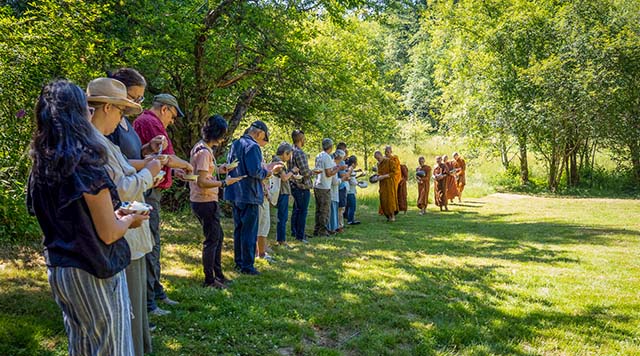
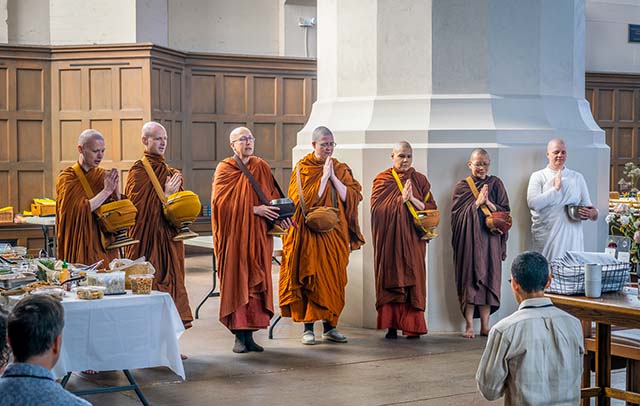
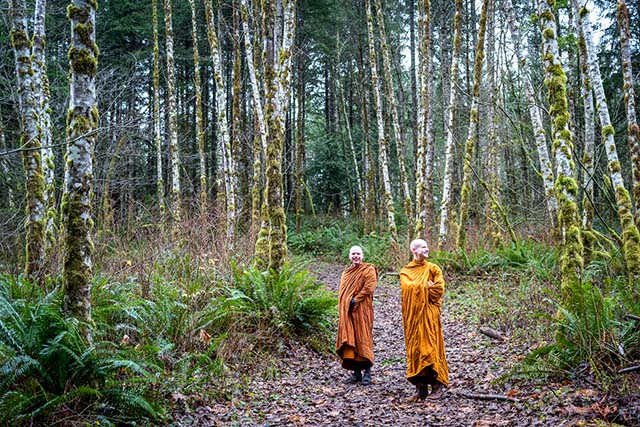
Monastics received alms at the Clear Mountain land in June, 2026, shortly after the land was purchased.
Photos by: Courtesy of Clear Mountain Monastery
Clear Mountain Monastery is moving into an important phase of growth and actualization.
After nearly three years of searching rural areas surrounding Seattle for a site, Clear Mountain on April 30 closed on a 50-acre parcel near the town of North Bend, east of downtown Seattle.
Purchase of a second adjoining parcel, which is 40 acres of forest, is expected to follow once a title matter is resolved. Then the entire 90-acre monastery property, only a 40-minute drive from downtown Seattle, will be near enough to the city for easy access by urban dwellers, while also secluded enough to support monastic retreat.
Crucially, there is enough buildable area to accommodate the eventual vision of Clear Mountain Monastery: 20 huts for monastics called kutis, a large temple, a multi-purpose hall, a workshop. The land is close enough to North Bend for monastics to go on daily alms rounds for their single meal of the day. The existing road entering the land from the west is wide enough to accommodate emergency vehicles and visitors’ cars.
Since 2021, when Ajahn Nisabho arrived in Seattle after years of monastic practice in Thailand, co-abbots Ajahn Kovilo and Ajahn Nisabho have been steadily nurturing the Clear Mountain community of dharma practitioners. While the monks’ daily lives have remained steadfastly connected to the simplicity of their Thai forest tradition — going for alms most mornings at Pike Place Market, and offering teachings on Saturday mornings — they have also built a dynamic online presence supporting and inspiring people on the path around the world, building a true community of mutual support for those near and far.
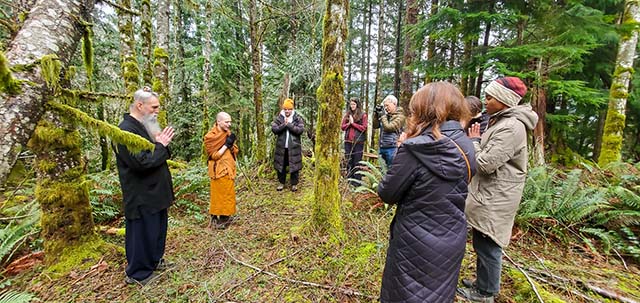
The online and in-person Saturday morning gatherings, at the Skinner Auditorium of St. Mark’s Episcopal Cathedral on Capitol Hill, have attracted people from around the region and from around the world. From this has grown a very strong relationship between the clergy of St Mark’s, and the monastics of Clear Mountain.
The future community of up to 20 monastics, will be open to the public in a variety of ways. People will be invited to morning and evening pūjas (chanting and meditation); to sutta and Pāli study; to online and in-person dharma teachings; to daily meal offerings. The schedule will include observance of Buddhist holy days, visits from guest monastics, and daylong retreats. The point of it all is to support people on the spiritual path, said Co-Abbot Ajahn Nisabho.
“Apart from a large temple able to hold several hundred people on celebration days, the monastery’s vision includes a multi-purpose hall, residence for visiting bhikkhunis, gardens, and forest paths,” he said. “It will be a refuge of peace for generations.”
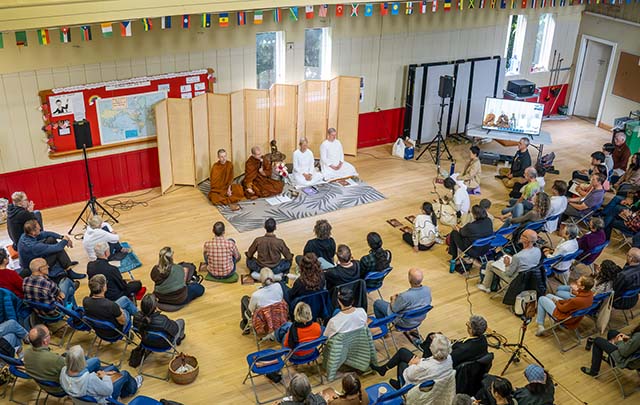
Aware that this vision will take many years to come to fruition, we are honored to follow the guidance of Taoist master ZhiCheng, who walked the land with us in late February. He encouraged us to listen to the land, to let the land tell us what it needs, where to build, and how to recognize and protect the places of natural power — counseling us to avoid enacting our will upon it, and instead to act as stewards for that which the land is moving toward. The land features a forest that serves as a migratory corridor for elk and other wildlife, along with wetlands and streams, and a view of nearby Mount Si.
We intend to follow the spirit of stewarding approach throughout the project, allowing the land to move on its own timing, to guide the choice of architects and project managers, and to nurture the qualities of patience and trust as we meet the challenges of the long road ahead with openness and wisdom. We keep our hearts and minds always oriented towards that ultimate goal: a monastic refuge for the Pacific Northwest. This is the work of generations, and it is underway.
Over the coming months, Clear Mountain will assemble a design team to develop a master plan for the property, which will in turn guide construction in phases over many years. In the short term, a volunteer land development and construction team has begun working with the land by establishing presence, caring for the forest, and laying the groundwork for what is to come.
The first steps involve getting the structures already present on the land ready for the monastics to inhabit temporarily. This transition has been a key focus as it will allow the monastics to move onto the land after month of summer retreat starting in early August, in their current kutis in Southworth. This retreat will be a time for the monks to draw in and dedicate to practice, made possible by the time and dedication of many volunteers.
As Clear Mountain supporters approach the monumental work of building this refuge into a monastery in the Pacific Northwest, we are turning our minds and hearts toward a long-term stable foundation. This includes creating healthy and supportive relationships with the local communities, the local people, who surround Clear Mountain’s monastic home.
On June 11, Ajahn Kovilo and Ajahn Nisabho, along with Friends of Clear Mountain Monastery Vice President Steve Wilhelm, met with several North Bend-area leaders to establish first essential connections. In meetings with North Bend Mayor Mary Miller, King County District 3 Councilmember Sarah Perry, and Snoqualmie Valley Regional Chamber of Commerce CEO Kelly Games, the monastics and the civic leaders explored the positive influence the monks will have on young people in the area, and the benefits of avoiding development and supporting nature.
The Clear Mountain monastics and lay supporters feel very much welcomed into the North Bend region, and look forward to many ways to support the flourishing of the North Bend community we are now joyfully part of.
To fund all of this, Clear Mountain’s global community of lay supporters collectively donated the full $4.93 million to purchase the two North Bend parcels. Community members also dedicated over 3.3 million recitations of the traditional Pali mantra of refuge in support of the effort.
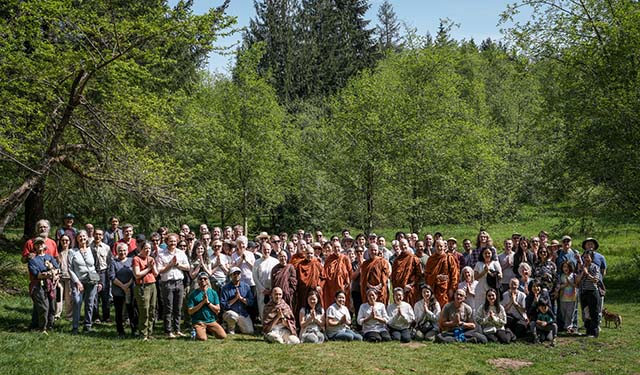
This passing of land into the stewardship of Clear Mountain Monastery represents a profound moment. On May 2, female bhikkhunis (monastics) from the small Port Townsend monastery called Parayana Vihara, and another in Olympia called Passaddhi Vihara, gathered on the land to celebrate with the non-monastic “lay” community. We walked the land together, chanting, sharing our hopes for the monastery, and setting intentions.
The community gathered around a large log near the boundary between the two parcels, near the place where a large temple hall is to be built at the center of the monastery. In ceremony we buried elemental offerings: earth from sacred sites in India, water, sage from the Pacific Northwest. We also hung a locally-made wooden birdhouse nearby.
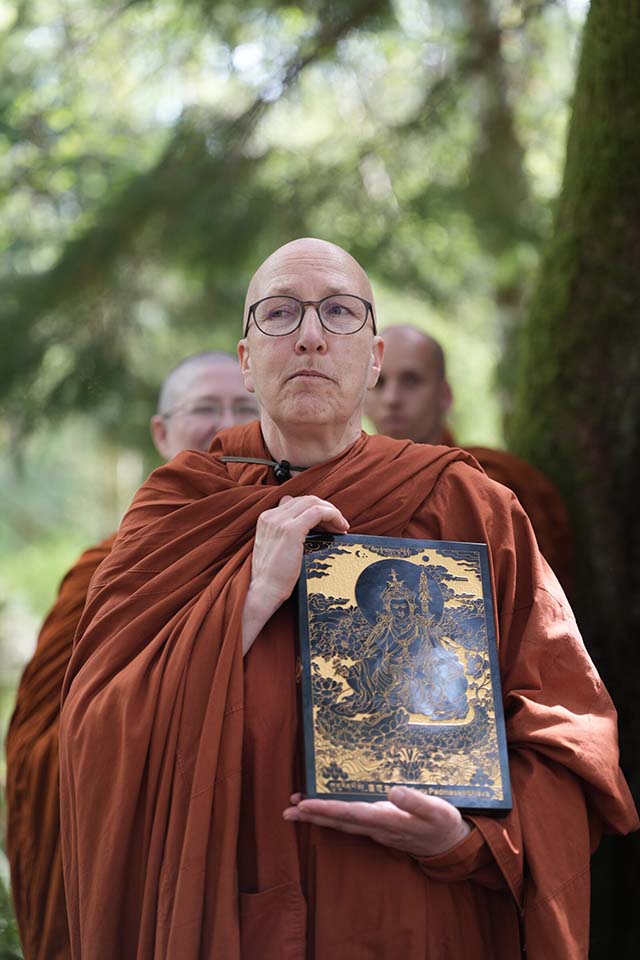
Then higher up in a grandmother tree we placed a sacred plaque of Padmasambhava, the founder of Tibetan Buddhism. This plaque was gifted to the monastery by Ayya Anandabodi, abbot of Parayana Vihara, and it is dedicated to compassion, world peace, and the liberation of all beings.
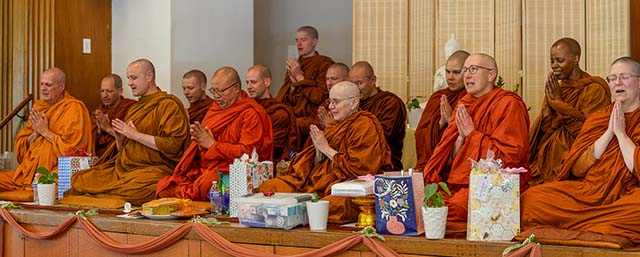
This same spirit of generosity was on display at the Clear Mountain Monastery annual kathina, or robe offering ceremony, on June 20. This ceremony has roots back to the time of the Buddha, and is a time for monastics and lay supporters to come together in mutual support.
This year Clear Mountain was visited by 17 monastics including Ajahn Sudanto, abbot of Pacific Hermitage a bit northeast of Portland; Venerable Ajahn Ritthi, abbot of Atamma Monastery in Woodinville, a town northeast of Seattle; Ayya Anandabodhi of Parayana Vihara; and the bhikkunis from Passadhi Vihara in Olympia. Also included was Maechee Pannasiri, a “white-robed female monastic” from Thailand, who has been visiting Clear Mountain for several weeks and sharing the dhamma with beautiful clarity.
It takes a large team of volunteers to pull together this kathina celebration, which draws hundreds of people together, and the entire celebration flowed smoothly from start to finish.
Another highlight from the week-long celebration was our time with Bhante Rahula, a monastic visiting from Mexico. He offered a Thursday evening talk at Seattle Insight, as well as a daylong retreat for the community following the kathina.
To carve out a space of stillness in the rush of the world is a profound act. As we pause at the inception of this Clear Mountain Monastery project, with its deep roots and new growth, the powerful potential of what we are building here together is palpable. May it benefit all beings everywhere.
If you appreciate our work, consider a donation.
Alexandra Haynes currently resides in Washington. She is a former land steward for Clear Mountain and lives dedicated to the support and practice of the Dhamma.
Kim Tull-Esterbrook serves as board president for Friends of Clear Mountain, the financial steward organization for Clear Mountain Monastery. She has been practicing with the Clear Mountain community since the first months of public gatherings. Her dharma gate opened in 1998, when she found her first Thich Nhat Hahn book in a used bookstore in Boulder, Colorado. Tull-Esterbrook is a mindfulness meditation teacher and yoga instructor, currently completing training as a mind body somatic coach.