
From South Korea to the Shoreline Sangha
Written by: Erika Bartlett
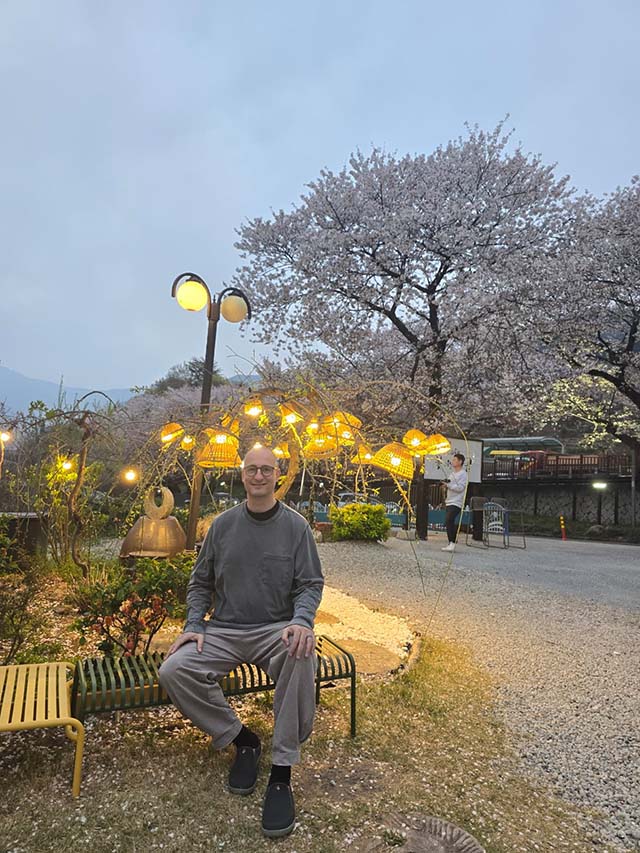
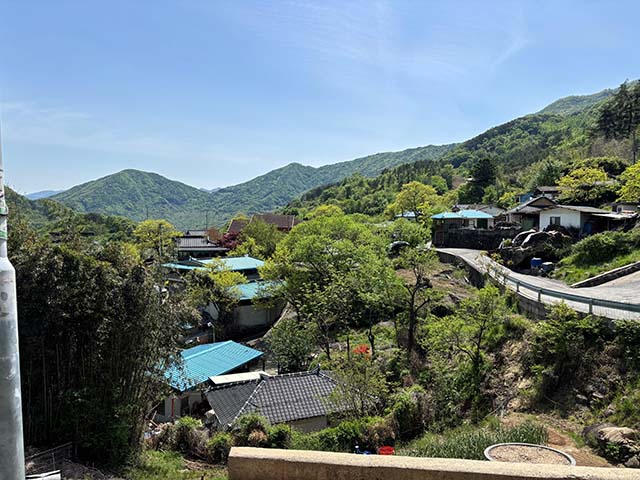
Jason Bartlett sitting in the village below the vihara.
Photos by: Erika Bartlett, Jason Bartlett, Vicki Blair
Mist lifts off the forested slopes of Jirisan, softening the South Korean mountain as morning settles in. Along a narrow path Jason Bartlett bends to gather herbs, his hands moving with easy attention. The leaves are damp, and the air carries a chill.
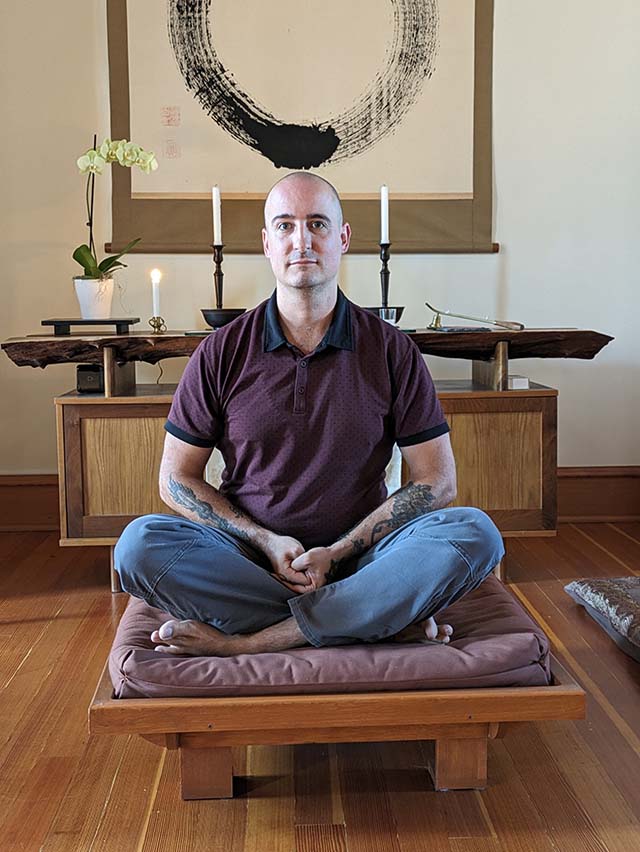
Bartlett, 49, leads the Luminous Dharma sangha, an active community that gathers for weekly online group meditation and instruction. Based in Shoreline, Washington, he also hosts retreats throughout the year, supporting students in individual and group practice settings.
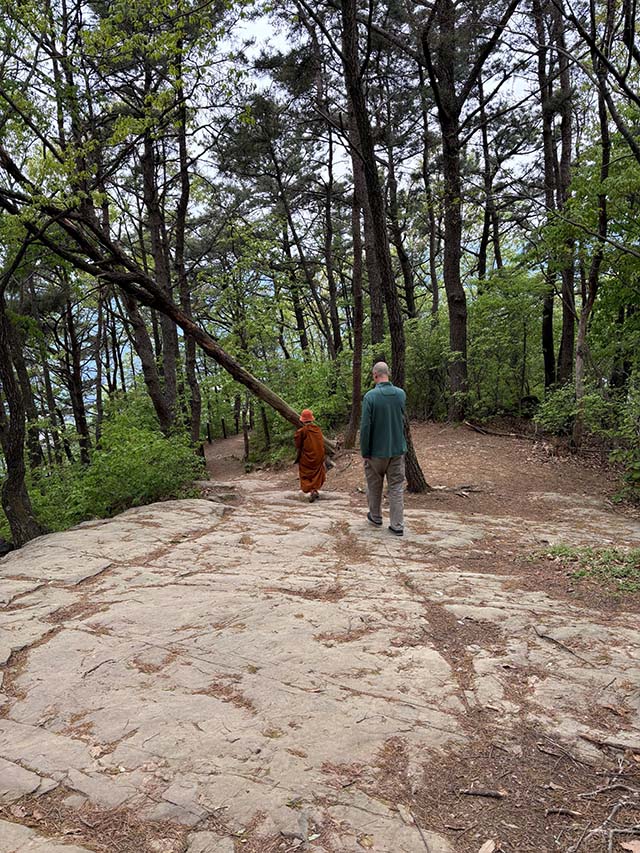
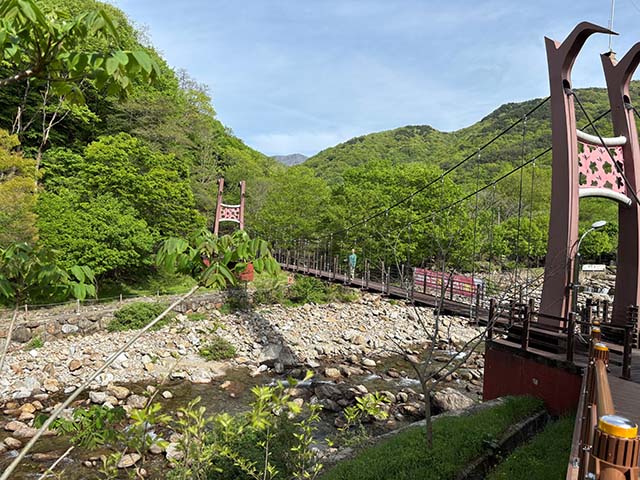
During April this year, Bartlett lived and practiced in Gurye-gun, South Korea, near the mountain hermitage of his longtime mentor Ayya Sucitta Mahātherī, a Theravada bhikkhunī. Here Bartlett moved through the role of student and caretaker. The days were shaped by simple action: chanting, picking herbs, brewing tea, and studying traditional folk medicine. Each task folded into the next, part of a rhythm that did not separate practice from the rest of life.
The tasks were ordinary and precise, gathering what was needed for the midday meal. Around him the mountain was quiet but alive. Water flowed somewhere out of sight, and below the vihara kept its steady rhythm. The visit served as a touchstone, for the dharma teaching Bartlett has brought back to his community in the Pacific Northwest.
“The green mountains tell me to live silently.
The clear, blue sky tells me to live without blemish.
To cast off greed, to cast off anger,
And live like water, like the wind– then pass on.”
– Seon (Zen) Master Naong
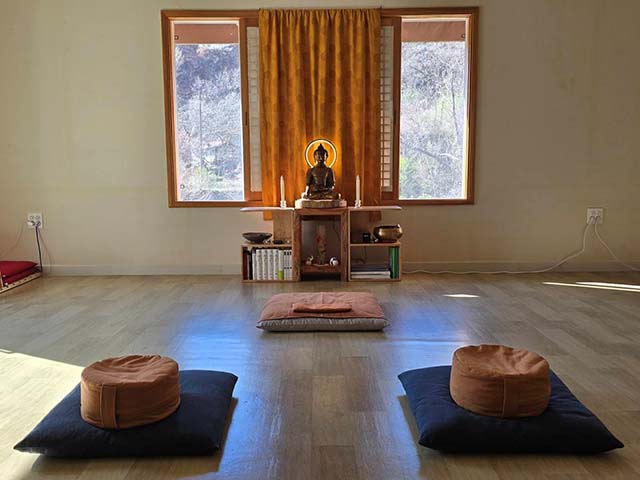
In his teaching role, Bartlett works in a style of dharma coaching or friendship. In addition to retreats and group sits, he works individually with practitioners through one-on-one sessions, in person and over Zoom.
Bartlett often works with seasoned meditators who feel they have stalled or are navigating significant shifts in their practice. He is known for helping practitioners navigate complex or confusing territory, including intense psychosomatic experiences, stages of awakening, and unfamiliar states of consciousness. Because of this specialization, other teachers often refer to him students needing this sort of guidance.
Bartlett’s ability to work with these situations is grounded in decades of dharma practice, along with training in Daoist practices, qigong, martial arts, and East Asian medicine. This combination allows him to meet experience not only conceptually, but physically and energetically, helping practitioners stabilize and integrate what is unfolding in their practice.
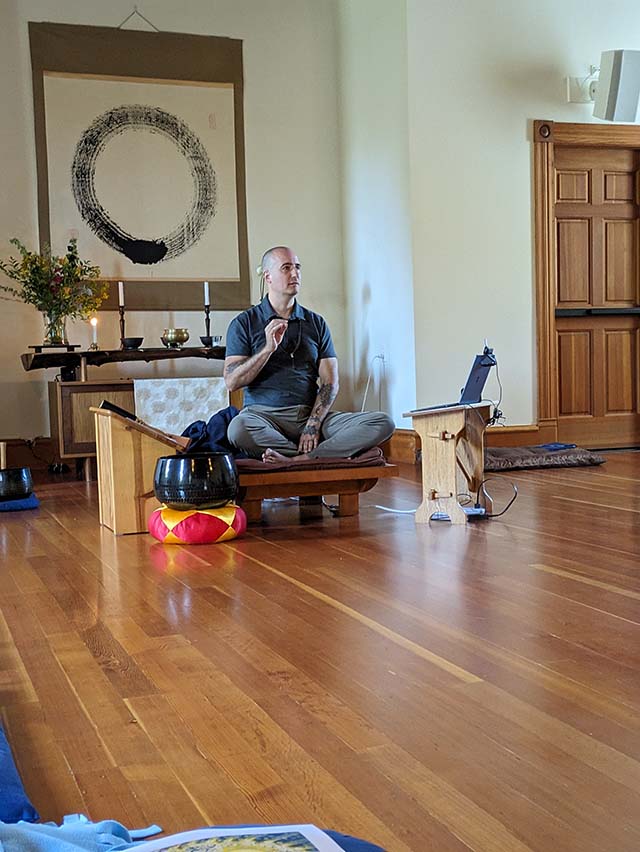
For Bartlett, practice and life are not separate. He teaches a felt, direct experience of freedom from entanglement. This is not a technique, but a genuine way of living.
“Practicing in this natural way revolves around learning to stop doing, observing and listening to what occurs when we’ve stopped, and learning to harmonize with this doer-less activity in ways that are kind, wise, and feel like a good fit,” Bartlett said. “In essence we are learning to put down what is extra, to feel and follow the situation as it unfolds.”
This is sometimes described through terms from Chinese Buddhism and Daoism:
- Wuwei (無為) — “non-action”: resting from doing and acting
- Ziran (自然) — “naturalness” or “spontaneity”: things arising of their own accord
- Weiwuwei (為無為) — “acting without acting”: feeling and following the situation, letting it unfold without forcing an outcome
If the explanation sounds complex, the practice itself is simple. Bartlett offers one such instruction:
“Take a walk at a comfortable pace.
While walking, feel what is occurring.
Soften anything in the body that can be softened. Soften any sense of doing.
Let walking continue on its own, comfortable, natural, and present.”
Bartlett’s natural approach began decades ago, while learning Zen, Chinese Buddhism, and early Daoism. For him, the way revealed itself intuitively through those practices. For years he sought teachers and traditions that spoke to his direct experience. He immersed himself in historical texts, suttas, and sutras, looking for language that could name what he had encountered.
He found elements of this natural way reflected across many streams including Pure Land, Chan, Seon, Zen, Himalayan Buddhism, Theravāda, and early Daoist teachings. Yet no single tradition contained the whole.
“This is like a boat following a current downstream.
Though you can say that it moves, the boat is at rest and there is no trace of movement.
This is called ‘moving without moving.’”
– Issai Chozanshi: “The Demon’s Sermon on the Martial Arts”
Bartlett’s work remains rooted in his relationship with the broader dharma community. Historically, Buddhist masters Bankei Yōtaku and Daehaeng Sunim have greatly inspired him. Among his mentors are Santikaro Upāsaka, Leigh Brasington, Seon Master Jeong Bong, and Venerable Wu Kai Shīfù.
Bartlett’s connection with Ayya Sucitta, the Korean Theravāda bhikkhunī, has been especially meaningful. Her practice, in her rural mountain hermitage on Jirisan Mountain in South Korea, reflects a similar emphasis on direct experience and harmony with natural law. The landscape is filled with forest, tea fields, and the quiet presence of the mountain.
Their connection grew from a shared recognition. In conversation, Ayya Sucitta encouraged Bartlett to continue grounding his teaching in direct experience, rather than relying solely on scriptural frameworks. He in turn felt deep affinity with her way of living and practicing, and was moved to support the conditions of her monastic life.
He now visits the hermitage at least once a year, staying near the vihara and helping where needed. His recent monthlong stay reflects this ongoing relationship, as well as the support of the Luminous Dharma sangha, which helps sustain the hermitage.
Back in the Pacific Northwest the setting changes, but not the practice. The lush hills of Jirisan are thousands of miles away, and in their place is the steady drizzle of a Tuesday morning in Shoreline. Outside is the hiss of tires on wet pavement, and the glow of streetlights reflecting in a puddle. The natural way is here, also. In the mist of the mountain or the damp grey of the city, the invitation remains unchanged.
“Just stay in the state of non-doing and all things will transform themselves.”
-Zhuāngzǐ
Ways to learn more
For those interested in exploring these teachings, much of Bartlett’s work is publicly accessible. His website, luminousdharma.org, serves as a central hub for his community, offering reading lists, sutta and sutra references, guided meditations, and retreat information, plus ongoing articles and reflections. Bartlett offers teachings freely on a donation-based model.
If you appreciate our work, consider a donation.
Erika Bartlett is a dog-loving, crocheting, firefighting Buddhist who lives in Shoreline with her husband Jason Bartlett (as above!). She enjoys international travel, and time with her family in the Pacific Northwest.