Pacific Northwest Peace Pagoda Finally Blessed
Written by: Glen Milner

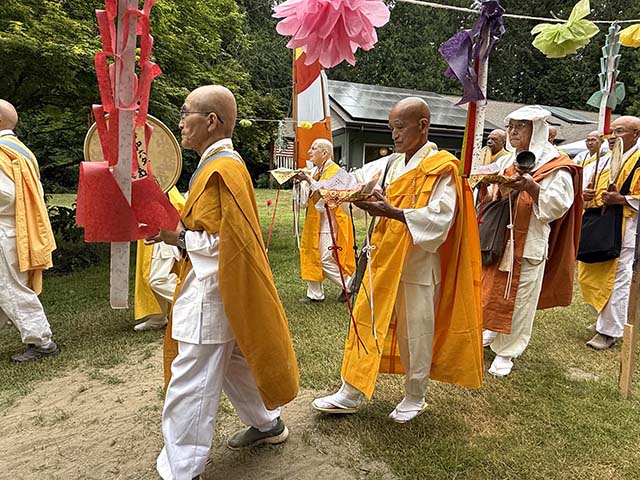
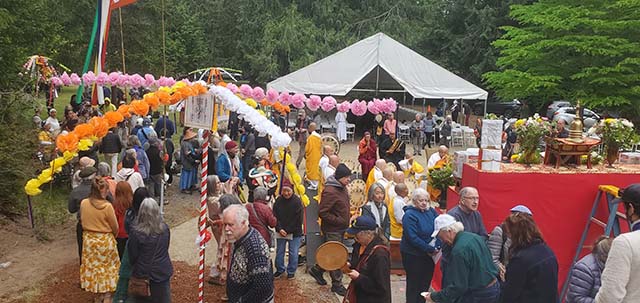
Rev. Kuniaki Onishi, who traveled from the Buddha’s birthplace in Lumbini for the peace pagoda blessing, prepares incense sticks at the altar just before the attendees start circumambulating the pagoda to the sound of peace drums.
Photos by: Lisa Eastop, Rev. Senji Kanaeda, Steve Wilhelm
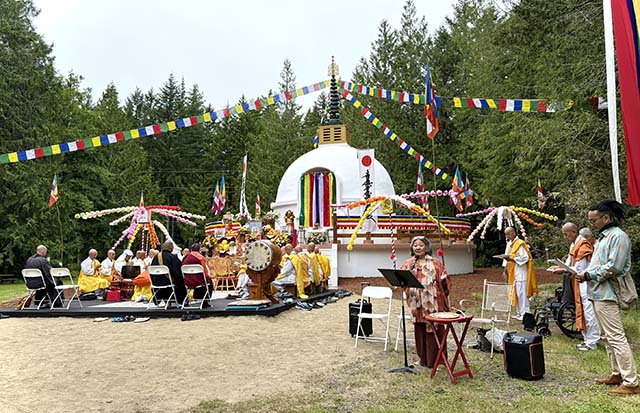
Forty five years after it was first launched, The Pacific Northwest Peace Pagoda was inaugurated with a sacred Buddhist ceremony, or Rakkei Shiki, on May 23, 2026, in Poulsbo, Washington.
Ninety monks, nuns, and supporters of the Nipponzan Myohoji Buddhist order came from around the world for the ceremony. Approximately 350 people attended, and here is a video of the event.
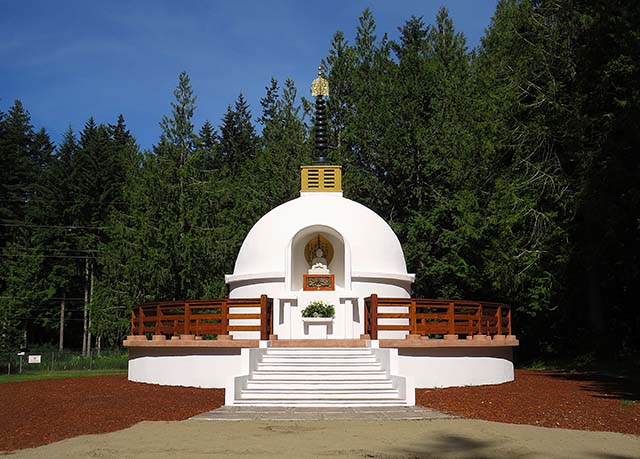
The Pacific Northwest Peace Pagoda is located on property owned by Ground Zero Center for Nonviolent Action, an anti-nuclear weapons organization that has maintained a close relationship with Nipponzan Myohoji monks and nuns since the late 1970s. The Peace Pagoda sits less than 100 feet from the property line of Naval Base Kitsap-Bangor, homeport of the largest concentration of deployed nuclear weapons in the world, in the form of Trident missiles aboard Ohio-class nuclear submarines. The stupa is just 20 miles west of Seattle.
The vision of the Peace Pagoda began in November 1980, when the Most Ven. Nichidatsu Fujii, founding monk of the Nipponzan Myohoji Buddhist order, declared that a peace pagoda would be built at “Ground Zero,” a reference to the Bangor base, to commemorate and support people being jailed for peace. Construction began in 1981, only to have permits revoked in 1982 by the Kitsap County Board of Commissioners.
But despite this setback, for many years the dream of a pagoda remained in the hearts and minds of many peace activists in the Pacific Northwest. Then in 2019 the Kitsap County Department of Community Development issued a new permit, and construction restarted at the same location.
Rev. Senji Kanaeda and Rev. Gilberto Perez, of the Nipponzan Myohoji Bainbridge Island Temple, are the monks who built the Pacific Northwest Peace Pagoda. Rev. Kanaeda said project leaders owe an “overwhelming debt to the bodhisattva deeds of Jim Lyman,” a retired contractor who oversaw the construction.
About a month after the inauguration, Rev. Senji Kanaeda and Rev. Gilberto Perez welcomed the public for a June 20 open house at the Pacific Northwest Peace Pagoda. The celebration was named “Homecoming,” and a small pavilion was set up honoring the birth of the Buddha. This is based on the legend that the newborn Buddha immediately took seven steps and declared, “I was born into this world to save people from suffering.”
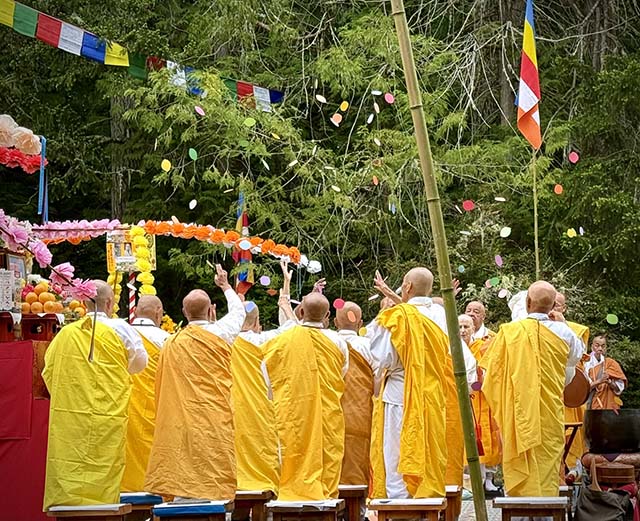
Over 100 people attended, and many of the visitors poured “nectar tea” over the head of a statue of the Buddha. After the ceremony participants celebrated with black forest cake, making a very pleasant day.
The Pacific Northwest Peace Pagoda is the first Nipponzan Myohoji Peace Pagoda in the western United States.
The Rakkei Shiki of the May 23 inauguration began with drums and prayers of North American Indigenous People. Tribal leader James Old Coyote said, “It’s an honor and a privilege to come here… and to witness the work, to witness the prayers that were laid down years and years ago.…It’s not by accident that we are all here. And each and every one of you carries medicine in your heart and in your spirit, that will be the saving grace of this crazy world we’re forced to live in right now.”
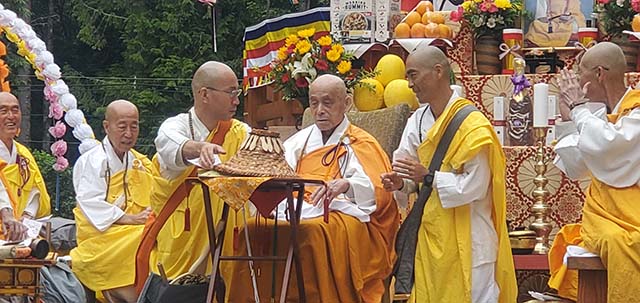
The Ven. Imai Gyoko, who will soon turn 96, is the most senior monk of the Nipponzan Myohoji Buddhist order. At the age of 17 he first became involved in the construction of Nipponzan Myohoji’s first Peace Pagoda after World War II. Since then he has devoted himself to the construction of numerous pagodas—including in Orissa, Vienna and London—right up to the present day. He stands as a living testament to the history of construction of Nipponzan Myohoji Peace Pagodas.
In his dharma talk, the Ven. Imai Gyoko said, “The founder of Buddhism, Shakyamuni Buddha, taught that when stupas (peace pagodas) enshrining the relics of the Buddha are offered throughout the world, this saha world (our living world fraught with suffering) instantly transforms into the land of tranquil light, swept by a pure and refreshing breeze. This is the scriptural foundation for peace and security in today’s world.”
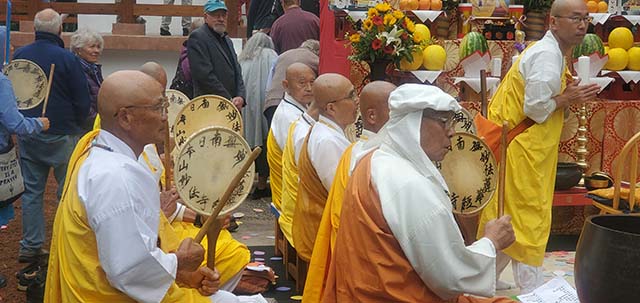
He added, “After World War II ended on August 15, 1945, as Japan struggled to rebuild following defeat, the Most Ven. Nichidatsu Fujii, founder of the Nipponzan Myohoji, vowed to erect stupas enshrining Buddha’s relics, the very essence of the Buddhadharma, as objects for people’s devotion and as prayers for peace.”
Ground Zero co-founder Shelley Douglass said in a written statement, “The Pacific Northwest Peace Pagoda stands, close to the fence, close to the nuclear weapons. After years of strong — and sometimes violent — opposition, the pagoda is a physical reality. It stands as a small example of what’s possible, of conversion from enmity to community, of patience and hope.”
Attendees at the Rakkei Shiki were reminded that they were standing at the same location where the Most Ven. Nichidatsu Fujii and others first met, and where construction of the Peace Pagoda originally began.
On June 14, 1982, at the Bainbridge Island Temple, the Most Ven. Nichidatsu Fujii said, “If Japanese Buddhism merely continues its daily routine of conducting funerals and such alongside the Japanese people, it will be utterly useless at this critical juncture. If Japanese Buddhism is to be of any use, it must work alongside the American people to destroy all nuclear weapons.”
He then added, “Even if this temple is burned down, even if the construction of this pagoda is banned, this is merely the plan of the government’s nuclear weapons faction. …This [their] endeavor will fail. Here we are building peace with a nonviolent attitude, without any conflict. Though invisible, its power is entering people’s hearts, the hearts of people throughout the world. We will surely eliminate nuclear weapons. This very place is the decisive battlefield.”
All are invited to visit Ground Zero and the Pacific Northwest Peace Pagoda throughout the year. Please contact us in advance for a convenient date and time. Please contact: Rev. Senji Kanaeda at (206) 724-7632 regarding the Pacific Northwest Peace Pagoda, or Ground Zero at (360) 930-8697 or info@gzcenter.org.
If you appreciate our work, consider a donation.
Glen Milner lives in Lake Forest Park, north of Seattle, and is a member of the Ground Zero Center for Nonviolent Action. He identifies with the Society of Friends.