
A Unique Collaboration Led to a Zen Koan Book
Written by: Katsuryu Bill Cooper
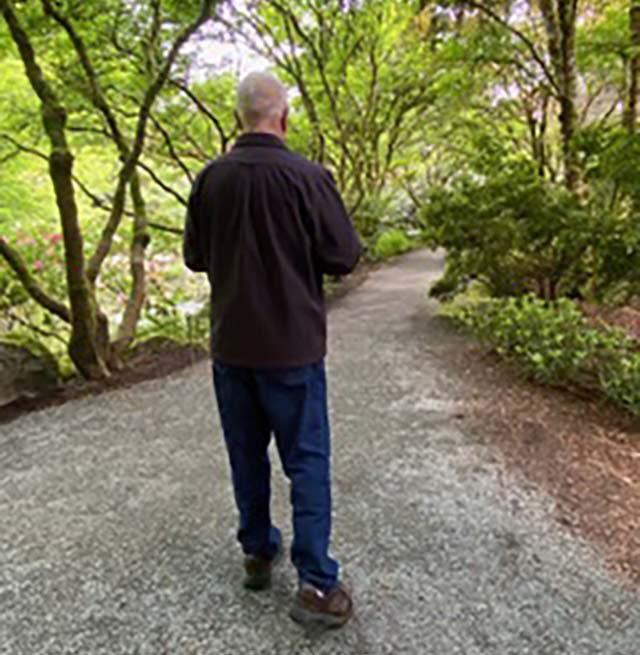
Katsuryu Bill Cooper, taking a break, in the bountiful Bellevue Botanical Garden.
Photos by: Bill Cooper, Ellen Cooper
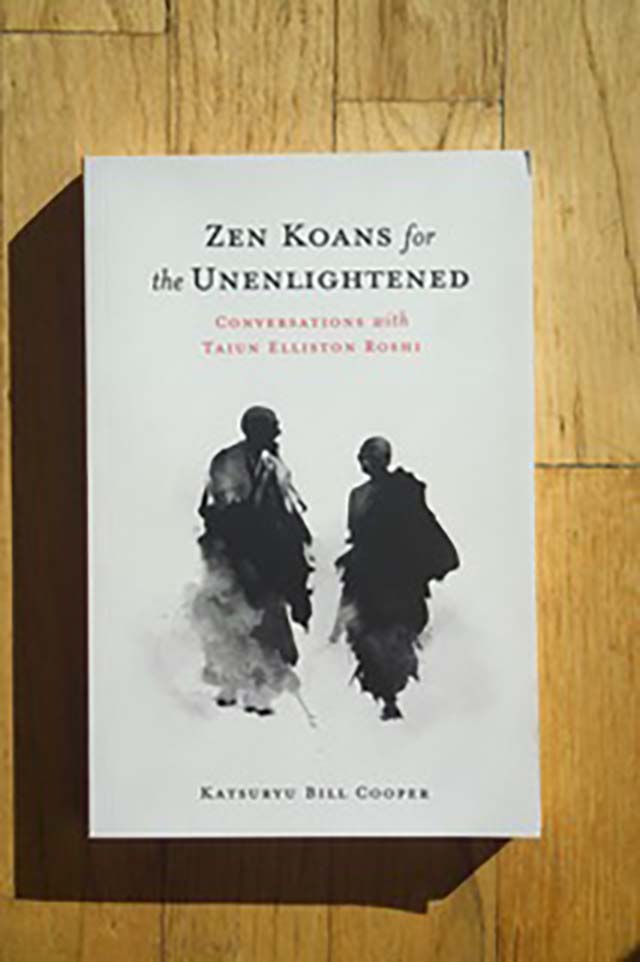
It’s not easy to begin training with a new Buddhist teacher. In May of 2020 that was the position I was in, but this discomfort has led to the creation of a just-released book – “Koans for the Unenlightened: Conversations with Michael Elliston Roshi,” – co-created with this new-for-me teacher.
But in May of 2020, most of what I was experiencing was discomfort. The few places I had practiced Buddhism, such as Wat Atammayatarama in Woodinville, were closed because of the pandemic. I was frightened, watching the daily, rising fatalities from the Covid-19 pandemic.
As the pandemic horror went on, I remembered how in the 1980s, my Zen teacher Soyu Matsuoka Roshi had spoken highly of his student Taiun Michael Elliston, who had trained in Zen with Matsuoka beginning in the 1960s. Now a dharma successor of Matsuoka, thus a roshi or entrusted teacher of Zen, Elliston has been teaching and practicing Zen at the Atlanta Soto Zen Center since the 1970s.
I’m not one to reach out–I had never met Elliston–but now something pushed me to contact him. I wanted to see what a dharma successor of Matsuoka Roshi was teaching. More importantly, I needed a friend.
Our book, “Koans for the Unenlightened: Conversations with Michael Elliston Roshi,” grew out of that meeting, and the teacher-student relationship that followed. The book is a five-year effort of transcribing, proofing, and editing our conversations about koans (Zen teaching stories) from “The Book of Serenity,” a 1,000-year-old Zen text of koans and commentary. We self-published our book in August 2025, with Amazon.

As expected, creating the book was not always a joy. I struggled with doubt, as I had never written anything this long. But “a book about Zen” has always been on my bucket list.
As I am now in my 70s I had some desperation about ever fulfilling this goal, but fortunately, Roshi Elliston steadily encouraged the work. In the end we produced a collection of 20 chapters: 17 about Zen koans from the “Book of Serenity,” and three chapters discussing major Zen teachers such as Bodhidharma and Huineng.
This book is our sincere effort to “translate” a few koans into modern understanding. Our hope is to encourage Zen students to look again at koans and visit these teachings, but with an additional emphasis on each student’s own experience and knowledge of Buddhism.
Most people who have read from a collection of koans will testify to their immediate difficulty. Koans can be striking and confusing.
Take for instance, the koan “The Woman of Taishan.” This koan-story, which can be found in “The Book of Serenity: One Hundred Zen Dialogues,” by Thomas Cleary, begins by describing an interesting woman at the foot of the trail to Mt. Taishan in China. Zen monks on pilgrimage would inevitably ask her, “What is the way to Mt. Taishan?” Strangely, she would respond the same way to everyone, saying, “Right straight on!” As soon as each monk passed, she would say, “A fine priest, they go that way, too.”
The koan continues. One day upon hearing of her, the nearby abbot tells his students, “Wait here until I check out that woman for you.” The abbot travels to the mountain trail–and he asks the woman the question, “What is the Way to Mt. Taishan?”
Then the next day this same abbot returned to the hall and said to his students, “I have checked out that woman for you.” This is the end of the koan.
Do you know what this means? I don’t, not right away. It takes time for me to get some pictures or thoughts and feelings. But I imagine I could say this: “Show me the road to Mt. Taishan! Be it!” or perhaps, “What do you mean, that woman!” There are many responses, if those are my own truth.
I could say, “Go right on,” quoting the woman. Perhaps I would then “walk right on” out of the room. I don’t know. However, if I spend time seriously looking at “The Woman of Taishan,” I believe it is likely that one “answer” may appear, an answer that unloads some of my confusion.
This is also a book of a growing relationship between Roshi and me, which unfortunately has always been on Zoom. We soon began meeting weekly about these unfamiliar koans; at least unfamiliar to me. I usually was in a mild panic before our meetings, thinking, “I have nothing to say!”
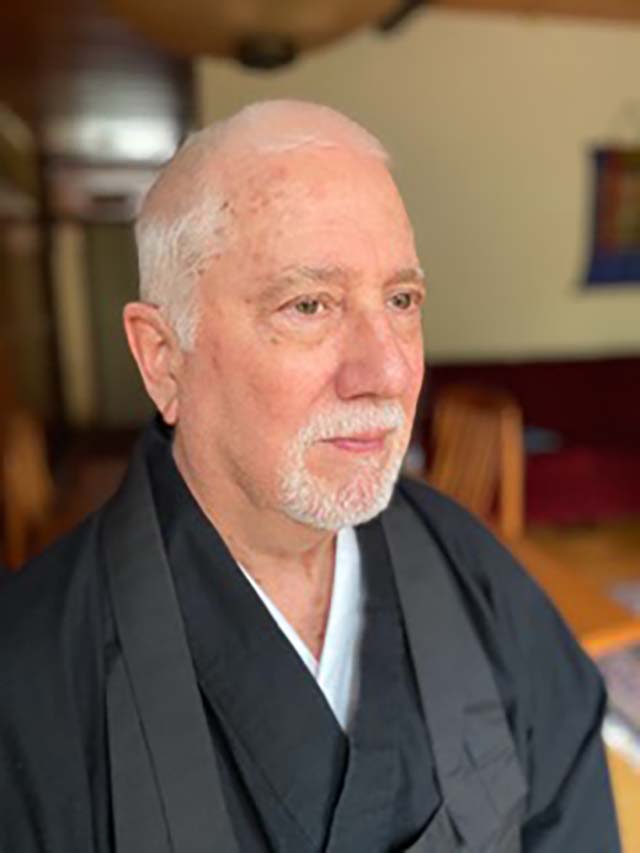
Of course Roshi was much more experienced in the dharma than I, and he knew what he was doing. Additionally Elliston Roshi drew comparisons between each koan, and a teaching of Dogen Zenji, founder of Soto Zen. I was often in awe of Elliston Roshi’s knowledge of Zen.
To Zen readers I would like to say, if you’ve ever been confused and turned off by koans, this book could help in supporting new experiences that include your knowledge. And yes, also included are your guesses about the dharma, the Buddha’s teaching. I think we should consider this: Perhaps there is no one-size-fits-all answers to a koan? Maybe we’re capable of having our own answers? Why not?
I realize that today’s conclusions may not seem right tomorrow. Things change, as we are taught. But I continue sitting and meditating with the mystery, and in the face of my ignorance.
I hope you will join Elliston Roshi and me in learning and studying Buddhism in our book “Zen Koans for the Unenlightened: Conversations with Taiun Elliston Roshi.”
If you appreciate our work, consider a donation.
Katsuryu Bill Cooper is the practice leader of Bellevue Dharma, a Zen affiliate of the Silent Thunder Order. He has practiced Buddhism for many years, most recently receiving shukke tokudo (Zen priest ordination) from Sensei Zenku Smyers of Mission Mountain Zen in Montana.
Cooper and his wife Ellen have lived in Bellevue since 1999, where they facilitated Bellevue Dharma for 12 years. Cooper now provides individual mentorship to Zen students. You may contact him at BellevueDharma@gmail.com.