
Three-Year Retreat Site Build Progresses
Written by: Amanda Taylor
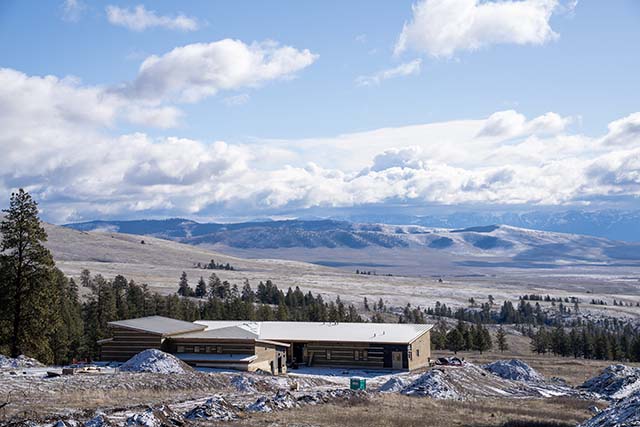
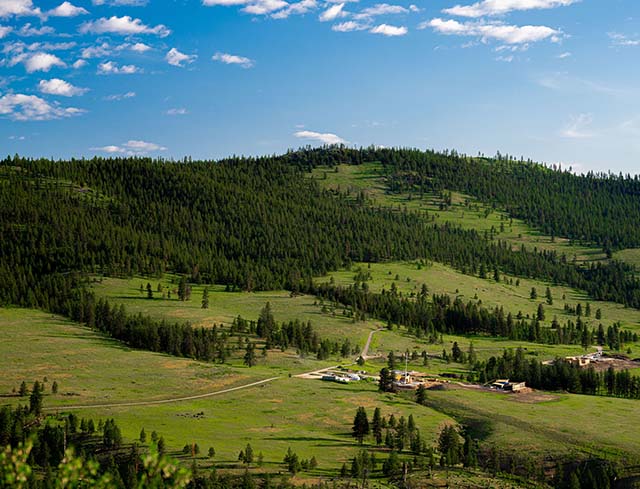
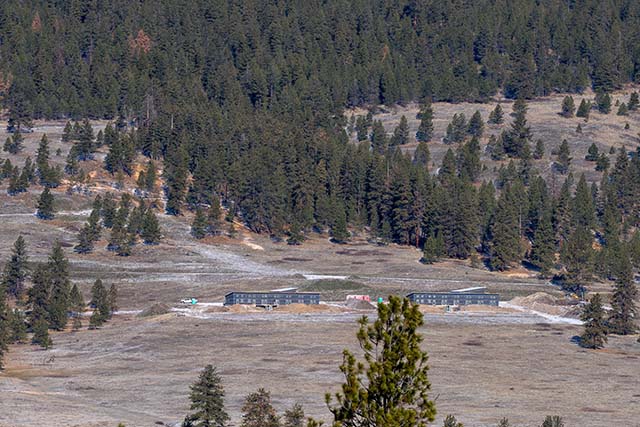
The three-year retreat buildings with a view of the Mission Mountains.
Photos by: Namchak Retreat Ranch
Namchak Retreat Ranch will offer a traditional three-year Tibetan Buddhist retreat in Montana in 2028, fulfilling a vision that has guided the organization since its founding.
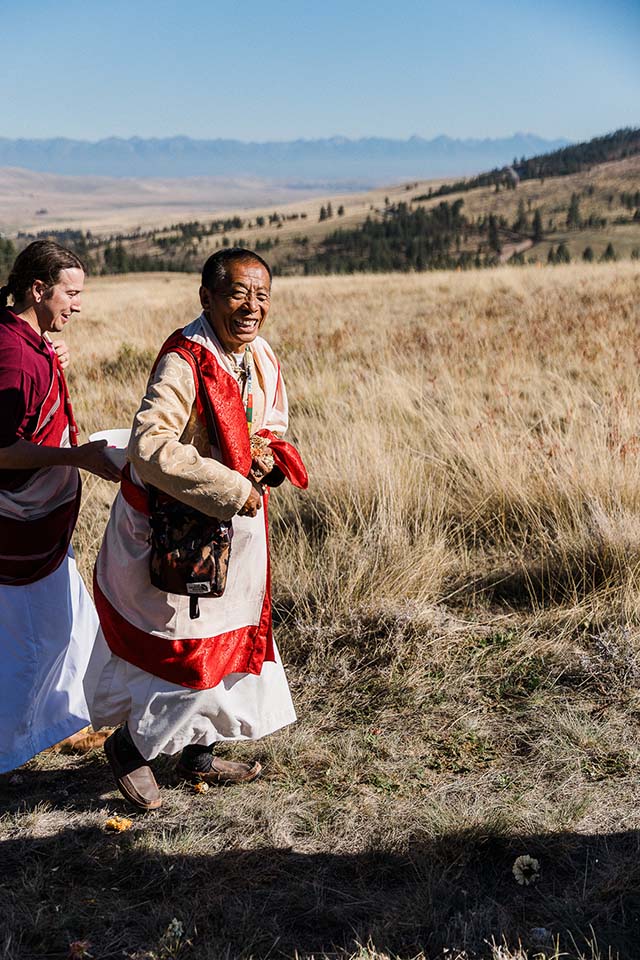
Led by Tulku Sangak Rinpoche, Namchak Khen Rinpoche, Dorlop Choenyi Sangmo and Lama Tsomo, the retreat will offer Western practitioners the opportunity to undertake one of the most rigorous and respected forms of training in Tibetan Buddhism. It will be a full-fledged three-year retreat in English, geared toward Westerners.
While three years probably seems like a long time to most Westerners, one doesn’t have to be a monk or a nun to complete such an undertaking. Richard Barron, a member of the Namchak Foundation’s Translation Committee, completed a three-year retreat in his 20s. When asked why he did it, he replied, “I don’t think any of us went into the retreat thinking, ‘I’m going to become a teacher’ or ‘I’m going to become a translator’ or something like that. It was, ‘I want to become a buddha.’”
Three-year retreat curricula and practices vary across schools and lineages of Buddhism. At Namchak, under the direction of Tulku Sangak Rinpoche, the translation committee is currently working on the texts that three-year retreat practitioners will use in their study and practice.
These texts will expose participants to the full range of techniques offered by the Namchak treasure (terma) lineage, providing a comprehensive, cohesively translated body of practice materials that can be chanted in English as well as in Tibetan. A terma refers to a root text hidden for future generations, often by Padmasambhava, the 8th century founder of Tibetan Buddhism.
Namchak also offers liturgies in English, making chanting accessible to English-speaking practitioners. Neuroscience has shown that the brain behaves quite differently while chanting than during regular speech. These retreats, along with other provisions for Western students, will allow participants to engage deeply with Dzogchen or Vajrayana practices, under the guidance of senior lineage holders and the retreat master Dorlop Choenyi Sangmo.
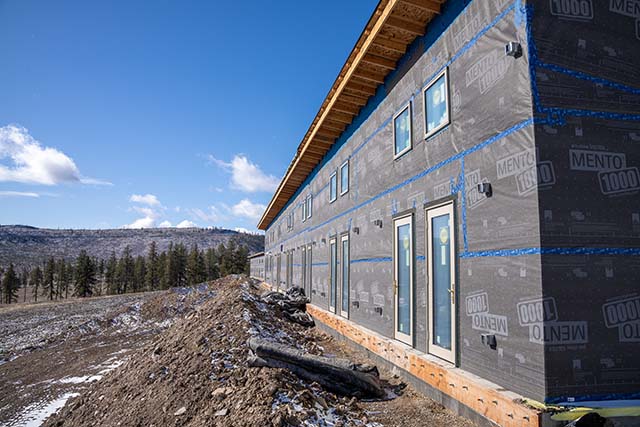
Construction of Namchak’s three-year retreat facility is to complete in 2027, with programming beginning in 2028. Built under the wide-open Montana skies, the facility includes buildings for men and women buildings, each with a capacity of 10 students. Each retreatant’s room will include a bed, a window, a private patio, a closet, a kitchenette, and a bathroom. With sustainability and the environment as primary considerations throughout construction, we have selected efficient, durable materials designed to last 200 years. Much of the food will be provided from the permaculture operation on the ranch.
It’s important to acknowledge that the Namchak Retreat Ranch lies in the homelands of the Séliš (Salish), Kootenai, and Ql̓ispé (Kalispel) people. We offer our respect for their history and culture, for their ancient and continuing presence in this landscape.

We have ongoing shared responsibilities to protect and honor this land. Namchak has always nurtured sustainable relationships with local indigenous communities by offering indigenous educational programming, bitterroot digs, native plant harvests, Salish language signage, and sharing permaculture harvests with the CSKT Food Sovereignty Program.
Tulku Sangak Rinpoche, the current primary holder of the Namchak lineage, has dedicated his life to preserving and transmitting the lineage in its complete form. Namchak’s three-year retreat fulfills his vision of offering Western students the opportunity to engage deeply in study, meditation, and realization, just as generations of students have done before in Asia.
His brother Namchak Khen Rinpoche, a scholar of the highest category who has completed years of strict solitary retreats, will provide many of the teachings. Dorlop Choenyi Sangmo, who will be in residence, is one of Rinpoche’s most accomplished nuns in the areas of scholarly practice and meditation experience. Lama Tsomo is a Westerner and experienced teacher who has done all of the levels of three-year retreat, who speaks Tibetan, and who is dedicated to providing a bridge for Western students.
The Tibetan word for retreat is tsam, which means “boundary.” Thus tsam denotes a sacred commitment, stepping away from the comforts and distractions of daily life, and into a space where profound transformation can unfold. To take this further, the Tibetan word for three-year retreat is lo-sum chok-sum, which means “three years and three fortnights.”
Three year retreat is a deep exploration of our inner energies. Given how many times we breathe in and out every day, there’s a connection between our breathing and the subtle energy that moves through our energy channels. When our minds are in a particular state of meditation, as we breathe the energy being reinforced is not ordinary karmic energy. That energy becomes wisdom or awareness, encouraged by particular breathing techniques.
The tantras state that the minimum time required for a human being to achieve full enlightenment, by transforming all that subtle karmic energy into the energy of wisdom or awareness, is three years and three fortnights. Hypothetically, if any one of us completely engages in these energy practices for three years and three fortnights, we will emerge as a fully enlightened buddha.
In reflecting on his own three-year retreat, Barron said, “There’s, of course, the sobering reality that you have to live with, where at the end of three years, you’re not a buddha yet.”
He further said, “One of the primary purposes of a three-year retreat is to expose participants to the entire range of techniques offered by that school. There are all kinds of more complex visualizations, use of mantra, yogic exercises, so by the end, regardless of how well you did and how much you accomplished spiritually, you were at least exposed to and had some training in all those techniques.”
If you want to stay informed about Namchak’s three-year retreat, fill out this form to receive updates.
Namchak offers a variety of programs with options for beginners all the way to three-year retreat. To learn more, go to namchak.org.
If you appreciate our work, consider a donation.
Amanda Taylor has been deeply dedicated to sharing Namchak’s mission and vision for over six years. She lives in Missoula, Montana, and is the marketing communications manager for Namchak.