‘Evangelical Zen’: Taking the Third Way Forward
(Not the Easy Way Out)
Written by: Paul Louis Metzger, Ph.D.

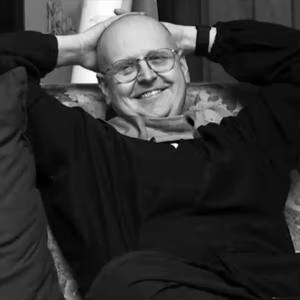
Professor of theology Paul Metzger is very engaged with Portland’s spiritual and religious activities.
Photos by: Stuart Mullenberg
A second edition of the unique “Evangelical Zen, a Christian’s Spiritual Travels with a Buddhist Friend,” contains a new foreword, a new introduction, a new concluding essay, and an afterword. It is intended to reinforce and extend this approach to embracing difference, to a new generation of readers.
The essays I wrote with responses from the late Zen Buddhist teacher Kyogen Carlson have not changed, given Kyogen’s passing just before the completion of the first edition. The book was born out of a unique dialogue, born out of respectfully honoring spiritual differences, between Kyogen and myself over many years.
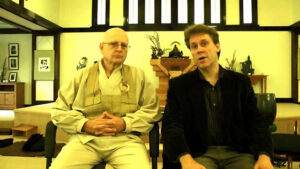
Kyogen was founder of Dharma Rain Zen Center in Portland, and for many years its abbot. He died of a heart attack in 2014.
The author of the new foreword is esteemed scholar of Japanese thought and culture Thomas John Hastings of Princeton Theological Seminary. Hastings wrote of Kyogen’s and my bond: “One would be hard-pressed to find this level of personal engagement in other Buddhist or Christian communities,” and “This disarming ‘interconfessional’ interchange points the way for those hoping to make spiritual friends within and across religious traditions.”
While the essays and responses that made up the first edition have not changed, what has changed are life circumstances, especially for my adult son Christopher. As a youth, he journeyed with my wife, daughter, and myself in Japan, a journey that serves as the backdrop for this book’s spiritual travelogue.
But Christopher endured a catastrophic brain injury in 2021. In this second edition I describe our ongoing journey since as a family, and how the interface of Christian and Buddhist themes of permanence and impermanence respectively have shaped my experience, including my reflections on Christopher and Kyogen.
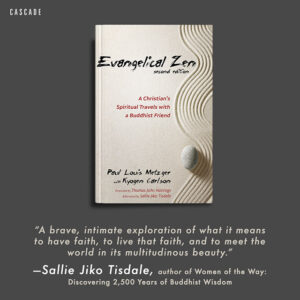
Such personal engagement of an interconfessional nature shapes the new material in this second edition, including the afterword by esteemed author Sallie Jiko Tisdale, who was a disciple of Kyogen, and is a Buddhist lay teacher.
Here I would like to reflect upon how my unique personal relationship and partnership with Kyogen, expresses what might be termed a “third way” forward in interreligious dialogue and life.
The volume is an exploration in taking this “third way” forward, which Kyogen and I pioneered many years ago. The “third way” calls to mind Zen Buddhism’s treatment of non-duality and duality, which I reflect upon in the second edition:
“Kyogen and I are ‘neither entirely unified’ nor are we ‘entirely distinct from one another.’ Ours is a third way forward reflective of Zen generally—‘not one’ and ‘not two’—neither ‘non-dualism’ nor ‘dualism,’ neither a fusion of the two traditions nor a separation of the two. Rather, a third way opens between or beyond them— ‘Evangelical Zen’.”
For more on this theme, refer to Shigenori Nagatomo’s discussion of “not one,” “not two,” and a third way that emerges in “Japanese Zen Buddhist Philosophy,” in “The Stanford Encyclopedia of Philosophy.”
Tisdale reflects upon this same trajectory in her afterword to the second edition of “Evangelical Zen.” She writes:
“Buddhism teaches the idea of ‘the third position.’ This third position entails stepping outside of the limited choices in a debate. This means being willing to stand in the midst of disagreement without engaging, resisting the urge to retreat to old ideas. In the third position, one can be composed and undisturbed while others fight next to you.” Later Tisdale writes, “This book is an expression of the third position: the place where one can’t take sides, because there are no sides.”
A Buddhist reviewer of the first edition of “Evangelical Zen” wrote that, “Conservative evangelical Protestants are rare in the Christian-Buddhist encounter genre, making ‘Evangelical Zen’ a noteworthy volume.”
Similarly, according to a Christian scholar in the field, this approach to interreligious dialogue is still rare, adding that the model embedded in the first edition did not receive the proper attention it deserved. He lamented the fact that all too often we are still caught up in well-worn patterns of minimizing differences and maximizing similarities, thereby limiting authentic and open engagement with people very different from ourselves. He and other endorsers from different traditions have wholeheartedly welcomed the second edition.
In our exchanges, Kyogen and I never denied our keen differences as if we were “entirely unified.” Nor did we fixate on our differences, viewing one another and our respective traditions with contempt. Rather, we embraced one another in a spirit of compassionate co-existence, cultivating trust with one another and with our communities.
As my evangelical Christian colleague John W. Morehead, executive director of the Foundation for Religious Diplomacy, reflected in conversation, Kyogen and I held “irreconcilable differences” in “peaceful tension in relationship.” (You can listen here to an interview Kyogen and I did with Morehead on our partnership, the day before Kyogen unexpectedly passed away on Sept. 18, 2014, of a heart attack.)
Taking the third way forward is never the easy way out. Kyogen would often say that the shrillest or harshest voices from the ends of the spectrum often get the most airtime. Even so it is important to stay centered and make headway, one potluck and one conversation at a time.
In fact, our friendship and partnership really started with a series of conversations over potlucks, which continued over many years. (You can read more about this story and work in Tisdale’s featured piece titled “Beloved Community,” in “Tricycle: The Buddhist Review”.)
Certainly Kyogen’s passing in 2014, the Covid pandemic shortly after, followed by my adult son Christopher’s traumatic brain injury, have made it difficult for us to continue these potluck dialogues with any consistency. And yet, we hope to restart them.
Kyogen’s Buddhist practice of mindfulness helped all of us guard against the mental and emotional triggers sabotaging transparent, open conversations. It was not that we discounted those triggers. Rather, we acknowledged them and placed them in a broader context of meaning, bound up with safety in a community of growing friendship.
Moreover, Kyogen demonstrated charity and curiosity, as well as humility, which safeguarded against self-righteous judgment. These constructive traits helped Kyogen and all of us seek to cultivate what social psychologist Jonathan Haidt would promote as a more expansive set of moral intuitions, which account for the strengths of people across the spectrum. (Please refer to his work, “The Righteous Mind: Why Good People Are Divided by Politics and Religion,” and the website MoralFoundations.org.)

You will find Kyogen’s ethos on display in his foreword, and his responses to my various essays in our spiritual travelogue that traces my inner pilgrimage weaving through one of my family’s sojourns in Japan. “Evangelical Zen” is, as I like to say, part Augustine’s “Confessions,” and part Robert Pirsig’s “Zen and the Art of Motorcycle Maintenance.”
Together in the book we traverse a wide array of cultural, social, and philosophical issues, including the culture wars, nationalism, xenophobia, climate change, permanence and impermanence, duty and grace, and like Zen, “wisdom and compassion in everyday events and encounters.” Kyogen and I perceive “reality in the concrete and immediate, not the abstract and remote. Individual experiences recapitulate the whole of reality,” as it says in the book. These perceptions manifest themselves in the search for what I often call “global humanity.”

How I wish Kyogen were still here to help me navigate the intensifying culture wars and process the searing pain of life since my son’s life-altering brain injury. Kyogen would adeptly engage these extremely challenging times and personal suffering with me. I would find great comfort in reflecting with him on our respective traditions’ founders’ distinctive emphases on the need to embrace the world in all its suffering, and to help others experience liberation.
Tisdale and I reflected on how much we wish Kyogen were still here, when we met in Portland for lunch following Christopher’s 2021 brain injury. And yet, as my closing essay to the second edition indicates, Kyogen is still here. The phrase “You Are Still Here” is the title of the epilogue to the collection of his teachings that Tisdale edited, and also serves as the title to that collection. Kyogen is still here in his various writings, in the hearts and minds of his Buddhist community, and in the heart and mind of his evangelical Christian friend. I am so thankful that we chose to take the third way forward together in life, rather than the easy way out.
If you appreciate our work, consider a donation.
Paul Louis Metzger, Ph.D., is professor of Christian theology and theology of culture, Multnomah Biblical Seminary, Jessup University; and director of The Institute for Cultural Engagement: New Wine, New Wineskins. He received his doctorate from King’s College London, University of London. Metzger has published numerous books, including most recently “More Than Things: A Personalist Ethics for a Throwaway Culture” (IVP Academic, 2023), and “Evangelical Zen: A Christian’s Spiritual Travels with a Buddhist Friend,” 2nd ed. (Cascade Books, 2024). He is a member of the Center of Theological Inquiry, Princeton, N.J.