
Tibetan Community Center opens in North Seattle
Written by: Jamyang Dorjee
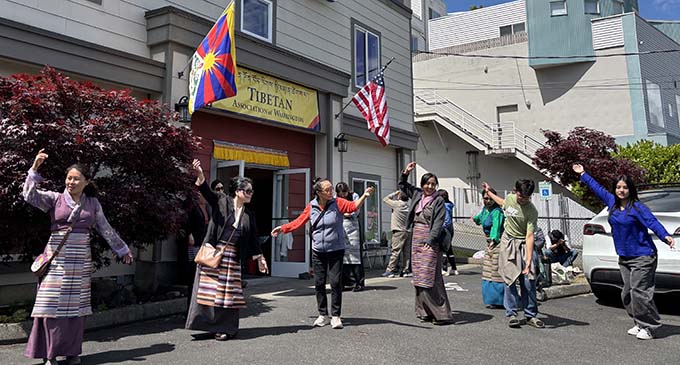
Members of the Tibetan community dancing gorshey, a Tibetan circle dance during the open house outside the Tibetan Community Center.
Photos by: Kurt Smith
Tibetans have lived in the Puget Sound region for over three decades, and finally the Tibetan community has the Tibetan Community Center as a place they can call home.
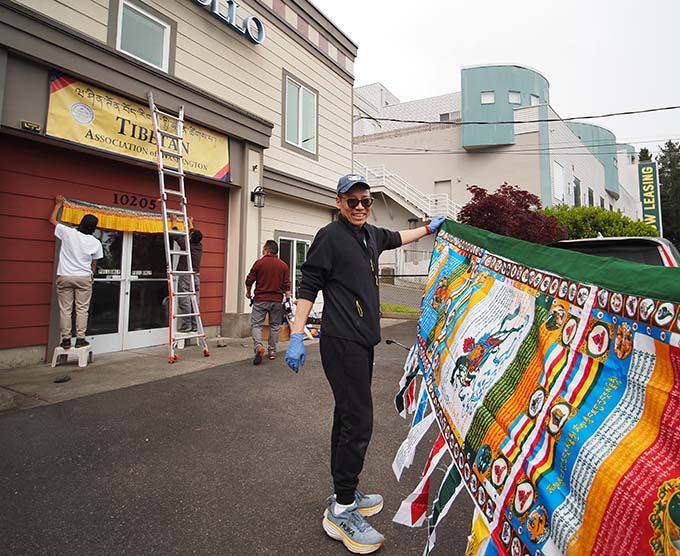
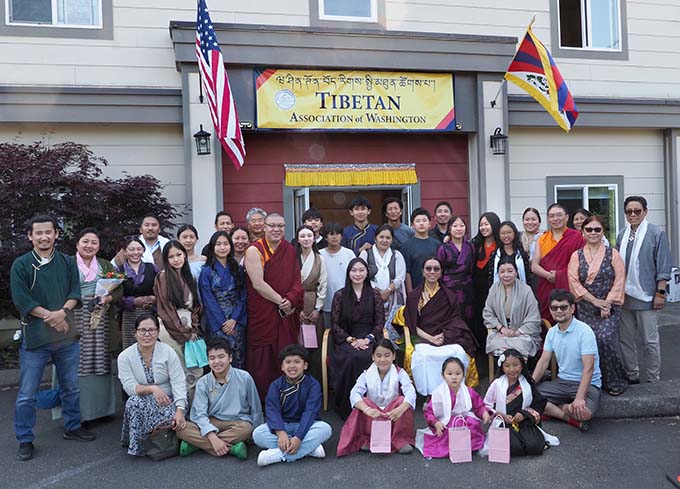
On May 5, 2025, the Tibetan Association of Washington took possession of a building along Lake City Way in north Seattle, to become their first Tibetan cultural and community center. The mixed-use commercial building, which formerly housed multiple offices and retail space, was acquired by the association in May for about $1.2 million.
Founded in 1989, the Tibetan Association of Washington (TAW), is a registered 501(c)(3) nonprofit that represents the Tibetan community in the Puget Sound region, which is centered on Seattle. For the roughly 300 – 400 members of the Tibetan community who live in the area, as well as for the overall Tibetan community in exile, this purchase is extremely important.
Tibetan communities in the majority of the cities in North America including New York, Toronto, Minnesota, and Denver, have slowly established their own community centers, helping those communities to flourish. These local Tibetan centers have helped Tibetan communities stay connected and better organized, and have brought a sense of belonging within the larger community.
“We were able to get here because of consistent strategy, followed through by dedicated and focused subsequent board leadership,” said Penjor Ngudup, a former Tibetan Association board member, who served on the Tibetan Community Center Building Committee while also serving as board treasurer.
The association’s primary work of preserving and promoting Tibetan language, history and culture is done through a variety of programs including the Sunday Tibetan Language and Culture School for the community’s youth, organizing the annual Tibet Fest at Seattle Center, and many other Tibetan events and festivals during the year.
In September, as the regular school calendar opened, a major milestone was achieved: The Tibetan Association of Washington for the first time offered the regular Sunday Tibetan Language and Culture School at the center.
In August the association held a formal center opening ceremony led by Avikrita Vajra Sakya Rinpoche. He is head lama of the Sakya monastery in Greenwood, third in line to lead the Sakya Buddhist order, and one of the grandsons of the late Jigdal Sakya Rinpoche.
In July the association welcomed Kundeling Tatsak Rinpoche, who made a stop while touring the U.S. to give teachings. Kundeling Rinpoche was a Gelug lama in his earlier incarnations, previously serving as regent of Tibet and senior tutor to the Dalai Lama.
In June the association welcomed Gyetrul Jigme Rinpoche to also bless the center. Gyetrul Jigme Rinpoche is a Kagyu and Nyingma lama, and holder of the Ripa lineage dating back to the 17th century in Eastern Tibet.
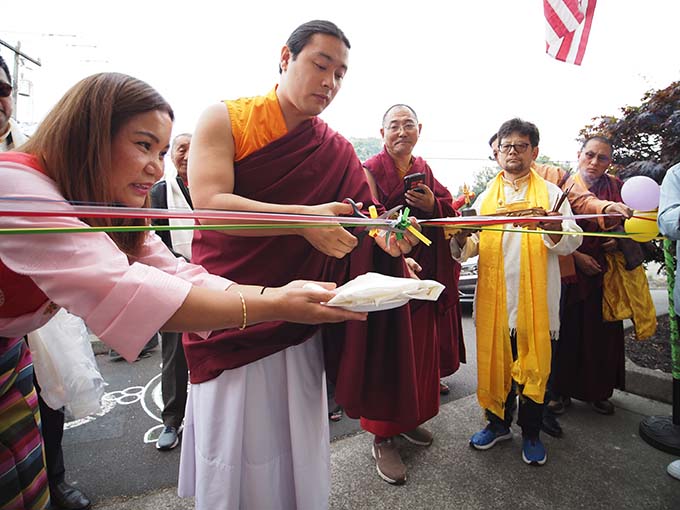
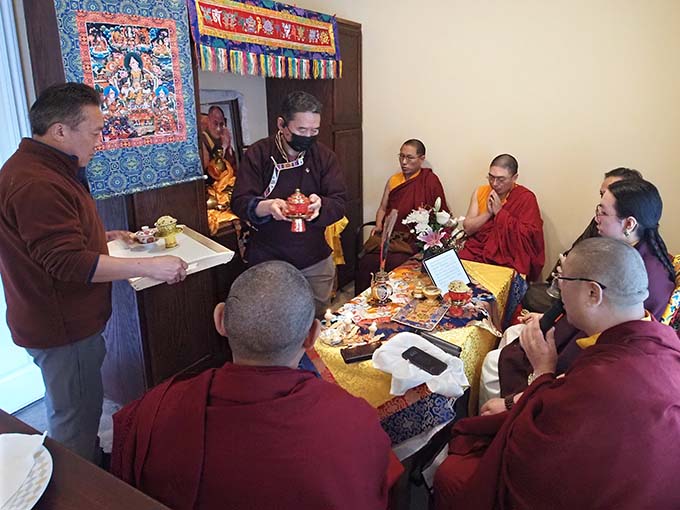
Tibetan Association of Washington had an open house in May for the community to see their new home, and invited Asanga Vajra Sakya Rinpoche to bless the center by performing a rabne, a Tibetan Buddhist consecration ritual. Asanga Sakya Rinpoche is one of the grandsons of the late Jigdal Sakya Rinpoche, from Sakya Monastery in Greenwood.
Earlier the community center building project faced a significant challenge, due to a lack of funds and rising commercial real estate costs. A 2021 feasibility study conducted by the committee confirmed that the project was not possible without a major capital grant or donation.
A dedicated Tibetan Community Center Building Committee spent years developing a new strategy, which involved hiring a grant writer and pursuing state and federal grants for minority communities. This effort was successful, with the association first receiving a series of smaller grants that increased their annual funds. They eventually secured a large grant in the 2023-24 Washington state biennium supplemental budget, as a result of their consistent lobbying and advocacy work.
In his testimony before the Washington Senate Ways and Means Committee, the legislative body that is responsible for the state capital and operating budgets, former association president Gonpo Yigontsang said,
“My parents escaped from Tibet on foot across the Himalayas when China invaded our country. I was born and raised in a refugee camp in Nepal, I escaped to India for a better education,…and now as a proud U.S. citizen, I reside in Shoreline with my wife and two sons.
“We are tired of running to seek home,” he said. “This community center represents more than just a building, it embodies the collective longing for a place to call home. We are a minority community dispersed in the Puget Sound region, struggling to maintain our identity. This center would be a learning center for our youth, a safe place where folks can speak their language, gather and preserve our language and culture.”
This was a story not unique to Gonpo, but containing elements shared by most Tibetan adults.
On February 17, 2024, Washington State Senator Manka Dhingra announced to a jubilant audience, during the association’s annual Tibetan New Year gathering, that the community center project had won a $1.02 million state grant. The grant was part of a community funding program through the Washington State Department of Commerce, which was awarded to Communities of Concern, a local coalition of communities from black, indigenous and other communities of color, including the Tibetan Association of Washington.
By the time the bill passed through committee the amount had decreased to $432,000, well short of the $1.5 million requested but still a significant and generous amount that got the association closer to acquiring a center. With this grant funding coupled with association savings, community pledges, and a bank loan, the association was now ready to start looking at properties.
Tibetan Association of Washington members remain eternally grateful to the Washington State Legislature for this investment in not just the Tibetan community, but in the community as a whole.
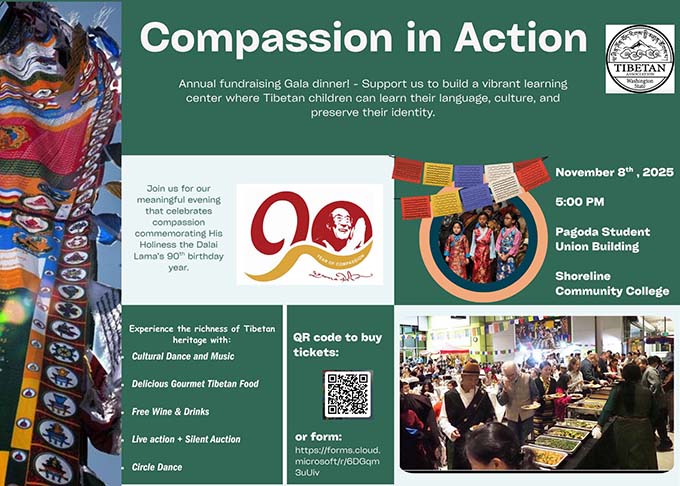
Now with the center opened, there is also distinct realization of the responsibilities, and the challenges that remain. The configuration of the 4,000-square-foot space is far from ideal, requiring significant construction and remodel work. The center’s location along a major highway is a safety concern for children attending the school. Parking is limited, as is space for larger gatherings and meetings. The association’s annual fundraiser event in the fall will become ever more critical, to sustain the momentum.
When I spoke to SuYoung Yun, a program manager at Asian Counseling and Referral Service who also testified for the association to receive the state grant funding, he asked if the center would be able to teach Tibetan language to the wider community.
I replied, “Yes and much more, that is the plan…once the center gets going.”
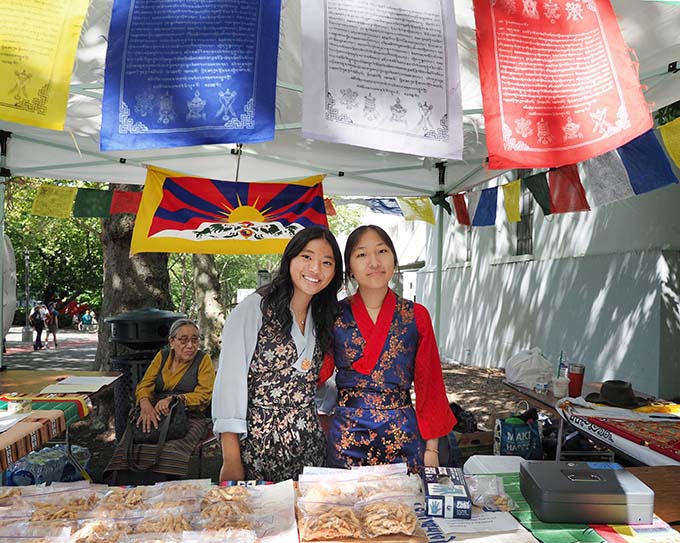
Some of the Tibetan community’s more notable public events in recent months have included:
December 6th – A visit by the 43rd Sakya Trizin Gyana Vajra Rinpoche to the new Seattle Tibetan Community Center, while on his tour of the United States. Rinpoche also gave a public talk on “Buddhism in Everyday Life” at Sakya Monastery in Greenwood. He performed a Vajrakilaya torma empowerment at the Lynnwood Events Center the following day.
November 30th – A visit by Ven. Thubten Chodron to the new Seattle Tibetan Community Center, where she spoke on her own dharma path and the importance of dharma in one’s daily life.
November 8th – The Tibetan Community Center annual fundraising dinner at Shoreline Community College.
Such is the potential for contribution, and an important reminder of the presence of Tibetans and the values they bring to the Pacific Northwest.
Jamyang Dorjee is a Tibetan Buddhist living in Bothell, Washington. He is a former president and board member of the Tibetan Association of Washington, and served on the Association’s Tibetan Community Center Building Committee. In his day job he manages public affairs for Community Transit. He also serves on the boards of ChildStrive, the Bothell Kenmore Chamber of Commerce and the Lynnwood Chamber of Commerce. He writes regularly for Northwest Dharma News.