
Seattle Soto Zen Stretching its Current Zendo
Written by: Kanshin Alison Tait and Tokushu Nathan Britton
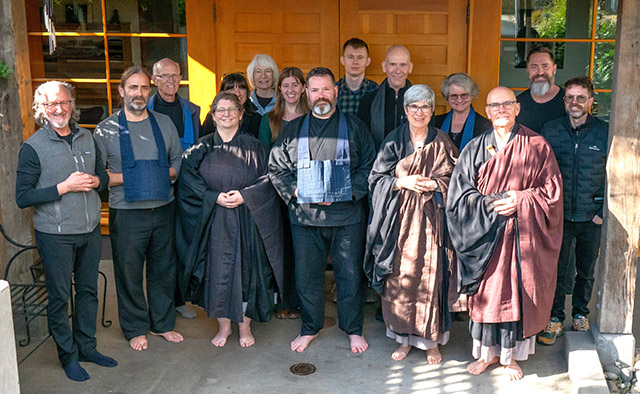
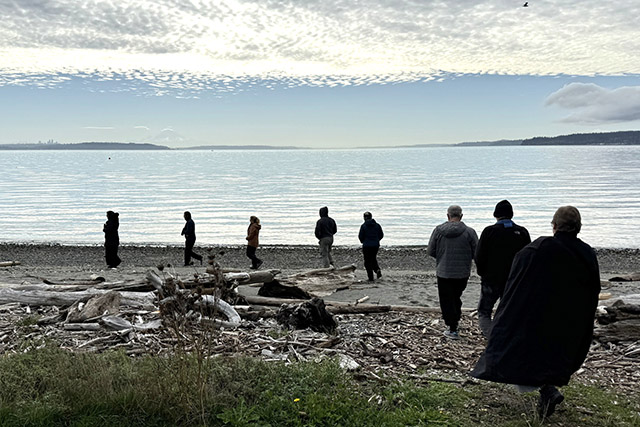
Participants from the fall Seattle Soto Zen sesshin. From left to right Tom Phillips, Nathan Britton, Michael Gillespie, Kanshin Alison Tait, Christina Johnson, unknown, Samantha Hilbert, Shuso Daiho Chris Middleman, Ilia Demianenko, Marco Beghin, Myoshin Kate McCandless, Susan Hautala, Shinmon Michael Newton, Benjamin Luedke, and Chris Reath.
Photos courtesy of Seattle Soto Zen
Seattle Soto Zen is growing briskly and looking for a new home with space for that growth, after navigating numerous challenges in the last six years.
The group is currently practicing out of a storefront on Capitol Hill, an urban Seattle neighborhood. This location has proven popular, partly causing the sangha’s sudden growth spurt.
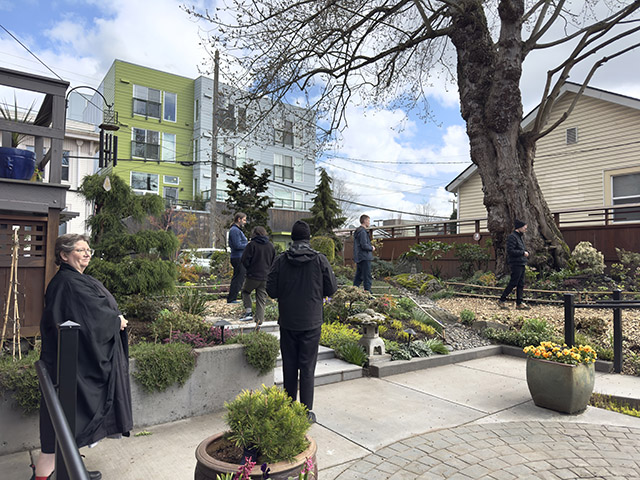
New practitioners are learning the roles of the doanryo, the people who accomplish various ceremonial functions in the dharma hall. Also a cohort of students are sewing their rakasus (a ceremonial Zen garment) in preparation for jukai (their taking refuge ceremony) in the fall.
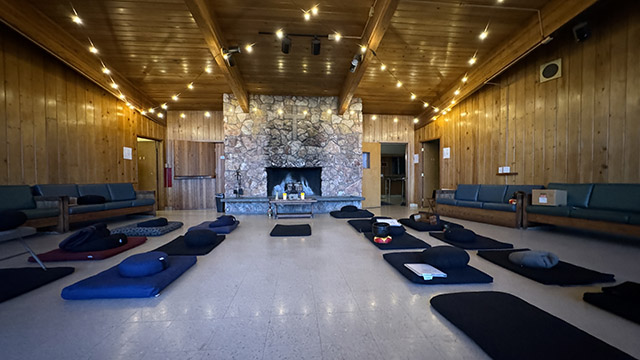
“We’re getting uncomfortably close to outgrowing this zendo soon,” said Resident Teacher Kanshin Allison Tait. “This is probably a good problem to have, though it’s kind of intimidating.”
Kanshin added that Fuel Coffee and Books on Capitol Hill has also become a place of practice.
“We made lists of pros and cons for moving Seattle Soto Zen’s zendo to Capitol Hill from the Queen Anne neighborhood where we’d been meeting for so long, but the coffee shop wasn’t on any of the lists, and it should have been!” she said. “People call going out for coffee together ‘the third sit,’ or the ‘third period of zazen,’ and it’s just lovely.”

The community is now stretching to respond to requests from students for more opportunities for longer retreats called sesshins and zazenkais, and more informal community events, Kanshin said.
“These are very good problems for a Zen community to have,” she said.
Seattle Soto Zen currently offers hybrid practice on Sunday mornings from 9 a.m. to 11 a.m., online morning zazen at 8 a.m. Mondays through Saturdays, early morning online zazen at 6 a.m. Wednesdays, zazen instruction on Wednesday mornings, and mixed programming at 7 p.m. on Thursdays.
“We just completed a practice period, and we had a very successful online class. Over the summer we’re experimenting with an informal Zen book club, reading “Zen Mind, Beginner’s Mind,” Kanshin said. “We’re calling it the ‘Summer of Zen.’ Ultimately, we’d like to be able to expand our hybrid offerings, with a dedicated zendo space that we could use as a home base.”
Kanshin has recently begun preparations for receiving dharma transmission from her teacher, Zoketsu Norman Fischer. Once complete, the dharma transmission ceremony will empower her to act as an independent teacher, and preside over practice periods and ordination ceremonies.
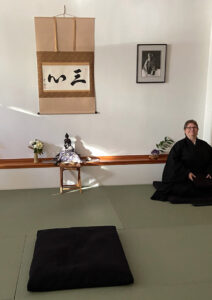
“I hope that this will allow me to serve the community in more ways, and offer more teachings and programming,” Kanshin said. “I do have a part-time job, and I am disabled, so I often feel disappointed that I can’t do more for my beloved sangha.”
With a laugh, she adds, “Maybe that’s also a good problem to have!”
This growing in-person activity is a steep change from the realities of the onset of the COVID-19 pandemic, when sangha leadership had to make the difficult decision to close the zendo. At that time Seattle Soto Zen moved to online-only practice, despite never having a streaming or virtual practice option before.
“It was a very steep learning curve!” remembers Kanshin.
This happened shortly after Kanshin’s 2019 move to Seattle from San Francisco, where she had been residing and practicing at the San Francisco Zen Center. In September of that year Kanshin was installed as resident teacher of Seattle Soto Zen, following the retirement of Eko Jeff Kelley.
After two years of gathering online only, Seattle Soto Zen began looking for opportunities to offer hybrid practice, with both in-person and digital practice options.
“This was also a steep learning curve!” laughs Kanshin. “We were only able to do it because of a very generous donation to cover the audio/visual technology.”
For about six months Seattle Soto Zen met every other Sunday in the dojo of Seattle Koyasan Buddhist Temple, before finding their current Capitol Hill storefront location.
“The people at Koyasan were excellent partners, and excellent hosts, but by the end of the year we’d outgrown that meditation space and we wanted to meet weekly,” said Kanshin. “Fortunately, our good friends at Seattle Aikikai reached out to us at that time, to ask if we’d like to meet there for our Sunday morning programming.”
Kanshin Alison Tait has been resident teacher at Seattle Soto Zen since 2019. She came to practice in 2004, and spent 10 years living at the Tassajara Zen Mountain Center and the San Francisco Zen Center. She received the precepts from her guiding teacher, Zoketsu Norman Fischer, as well as her name Kyoji Kanshin, meaning “Humble Self, Generous Heart.” She was ordained by Fischer as a Zen priest in 2013.
Tokushu Nathan Britton came to practice at the Berkeley Zen Center in 2020. He moved to Seattle in 2021, and received the precepts from his teacher Ryushin Andrea Thach in 2022, along with the name Tokushu Egen, “Virtuous Shelter, Manifest Wisdom.” He currently serves as the president of the board of Seattle Soto Zen.