
Record Set as Tibetan Nuns Win Geshema Degrees
Written by: Judith Rose
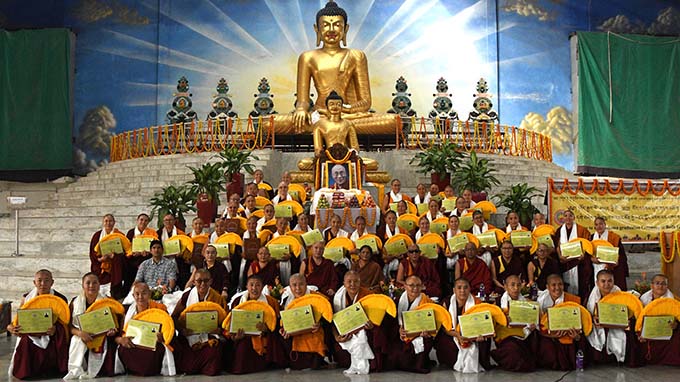
The 47 new geshemas, at their November graduation ceremony in Bodh Gaya, India.
Photos courtesy Dolma Ling Media Nuns, Tibetan Nuns Project.
The Tibetan Nuns Project’s Seattle headquarters office is celebrating the record number of nuns who passed the 2025 exams for geshema degrees, the equivalent of doctorate degrees in Tibetan Buddhist studies.
Forty seven Tibetan nuns passed their fourth-year exams to be formally recognized as geshemas. One hundred and seven nuns took and passed the three lower levels of exams, leading to the geshema degree. The overall pass rate was an impressive 96 percent. The geshema degree is the same as the geshe degree for male monks.
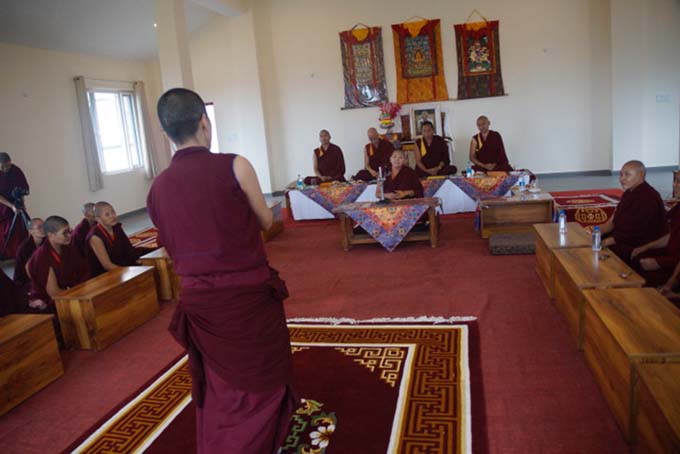
Overall, 74 of the 154 nuns who passed the examinations leading to the geshema degree –nearly half – are from one of the seven nunneries supported by the Tibetan Nuns Project, also known as TNP.
More specifically, of the 47 new geshemas, 19 are from nunneries supported by TNP. Twelve of the 31 nuns who passed the third-year exams reside in TNP-supported monasteries. Three of the 32 nuns who passed the second-year exams, are from nunneries TNP funding helps support. Regarding those who took the first-year exams, twelve of the 44 reside in monasteries supported by TNP.
The geshema degree, geshe for males, is the highest level of training in the Gelug tradition of Tibetan Buddhism. The title geshe was first applied to esteemed male masters such as Chekawa Yeshe Dorje, 12th century author of the Seven Points of Mind Training. For nearly 900 years this degree was reserved for men.
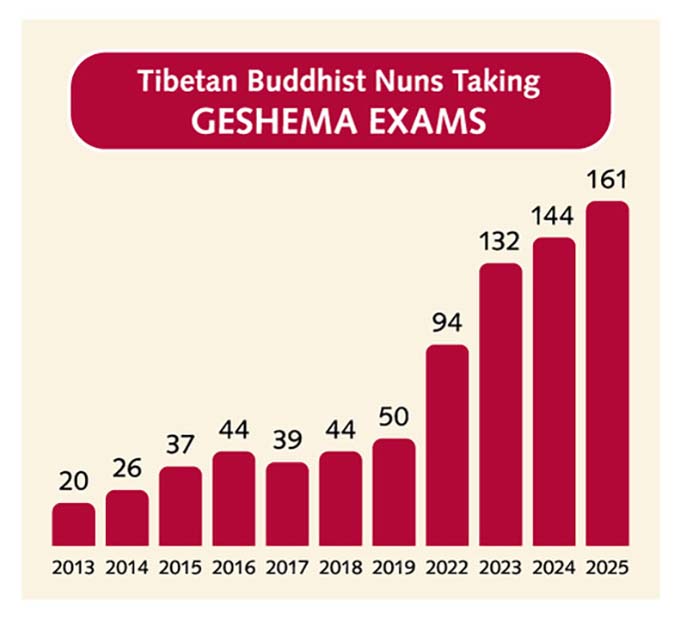
Finally, it was formally opened to women in 2012, at least partly as a result of encouragement from the Tibetan Nuns Project. This opening of higher degrees for nuns is a historic breakthrough, as only holders of these advanced degrees are eligible for certain leadership and teaching roles in their monastic and lay communities.
Nuns soon began responding to this opportunity for advanced education. On December 22, 2016, His Holiness the Dalai Lama awarded the first group of 20 Tibetan Buddhist nuns with geshema degrees, at a graduation ceremony at Drepung Monastery in Mundgod, South India.
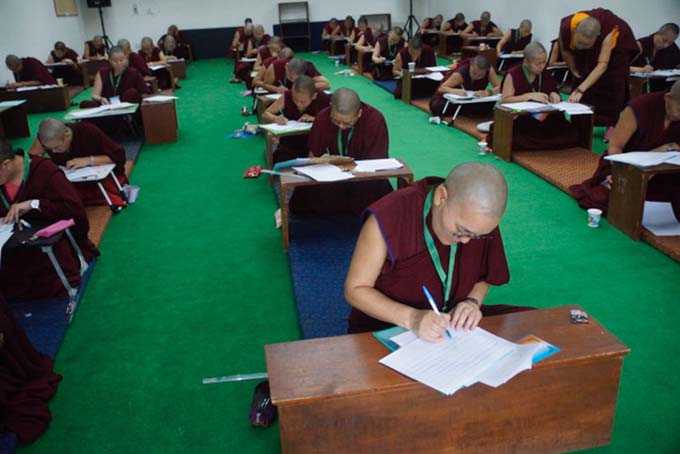
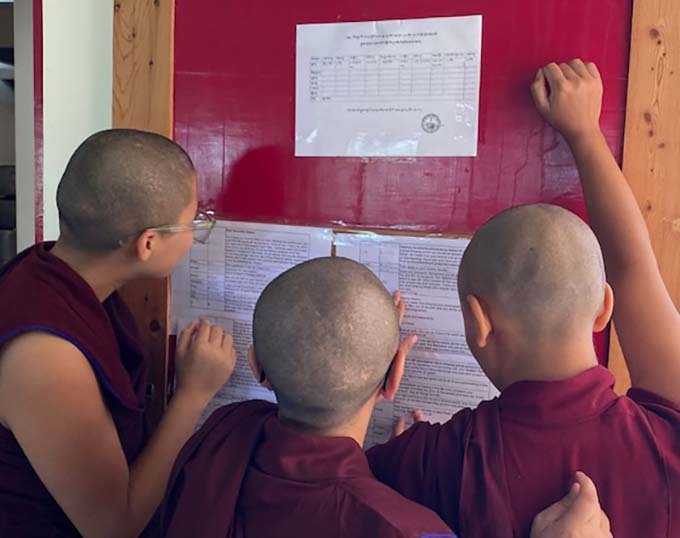
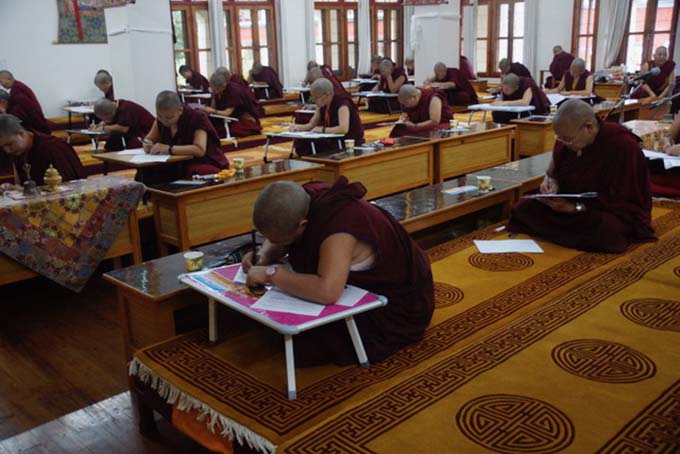
The 2025 exams were hosted by Dolma Ling Nunnery and Institute, near Dharamsala, in northern India, from July 21 to August 16. Dolma Ling was built and is supported by the Tibetan Nuns Project, with the nuns having actively participated in the construction. In April of 2025 the nunnery’s leadership transitioned from a male principal to that role being shared by three nuns, two of whom are geshemas.

The exams take four years to complete. Each of the four sets of exams is held annually over two weeks. Candidates are examined on the entirety of their 17-year course of study of the five great canonical texts, covering the Abhidharma (higher knowledge), Prajnaparamita (the perfection of wisdom), Madhyamaka (Middle Way), Pramana (logic), and the Vinaya (moral and ethical conduct). A nun’s eligibility to sit the exams is dependent on her having achieved a score of at least 75 percent during her studies.
The nuns taking part in the exams gathered at Dolma Ling in late June, one month before the exams commenced. The costs of the nuns’ travel, food, and the exam process were covered by the Tibetan Nuns Project’s Geshema Endowment Fund. The early arrival offered nuns a final opportunity for instruction, study, debate and group discussion, at the exam site.
The formal graduation ceremony for the 47 new geshemas took place in November, after the annual inter-nunnery debate in Bodh Gaya, India. These debates are also sponsored by TNP. The graduation will bring the total number of geshemas to 120.
In 2025, nuns took and passed the exams in the following numbers:
4th and final year: 49 nuns took the exams, 47 passed
3rd year: 31 nuns took the exams, 31 passed
2nd year: 33 nuns took the exams, 32 passed
1st year: 48 nuns took the exams, 44 passed
Gratitude to His Holiness the Dalai Lama
The success of these nuns would not be possible without the support and encouragement of His Holiness the Dalai Lama, patron of the Tibetan Nuns Project. As this recent article outlines, His Holiness “encouraged nuns to become advanced degree holders as part of his broader goal to increase gender parity.”
“Biologically there is no difference between the brains of men and women, and the Buddha clearly gave equal rights to men and women,” His Holiness the Dalai Lama said in 2013. In 2018, he said, “In the beginning when I spoke about awarding geshema degrees, some were doubtful. I clearly told them that Buddha had given equal opportunity for both men and women.”
In 2016, the Dalai Lama presided over and granted 20 Tibetan nuns geshema degrees, four years after he and the Tibetan government in exile recognized the accreditation of higher degrees for nuns. Before the formal development of the geshema program, only one German nun, Kelsang Wango, had received the degree, in 2011. Counting those geshemas who graduated in 2025, there are now 120.
Following are the graduation counts since women were first allowed to take the geshema exams in 2012:
- 2016: 20 nuns became geshemas
- 2017: 6 nuns graduated as geshemas
- 2018: 10 nuns became geshemas
- 2019: 7 nuns graduated at the end of November
- 2020: exams cancelled due to the pandemic
- 2021: exams cancelled for a second year due to COVID
- 2022: 10 nuns became geshemas
- 2023: 7 nuns graduated
- 2024: 13 nuns graduated
- 2025: 47 nuns graduating in November
Long-Term Stability
The costs associated with the annual Geshema exams are covered thanks to the 159 donors to the Geshema Endowment of the Tibetan Nuns Project, including the Pema Chodron Foundation, the Pierre and Pamela Omidyar Fund of the Silicon Valley Community Foundation, the Frederick Family Foundation, and the Donaldson Charitable Trust.
Headquartered in India, with the North America office in Seattle, the Tibetan Nuns Project is a 501(c)(3) charity established in 1987 to provide education and humanitarian aid to Tibetan Buddhist nuns living in India. The Tibetan Nuns Project supports over 800 nuns and seven nunneries in northern India from all Tibetan Buddhist traditions, as well as nuns living on their own and in retreat.
The Tibetan Nuns Project office is in the Inscape Building on the south edge of Seattle’s International District. This United States office handles the sponsorship of nuns, donations, and the sale and shipping of products blessed and sometimes made by the nuns.

For those readers interested in supporting the Tibetan Nuns Project or the nuns themselves, the project is always very grateful to those who sponsor nuns and help them on their path. More sponsors are always needed. One can learn more about sponsoring a nun here.
Another giving option is to the Long-Term Stability Fund, which is a quasi-endowment fund. This fund helps the Tibetan Nuns Project move beyond a year-to-year dependence on gifts, which can vary considerably with economic conditions. Its purpose is to assist current and future Tibetan Buddhist nuns, and to keep the ancient wisdom tradition of Tibet alive.
TNP’s Founding Director and Special Advisor Rinchen Khando Choegyal has said, “Educating women is powerful… It’s about enabling the nuns to be teachers in their own right, and to take on leadership roles at a critical time in our nation’s history.”
Judith Rose began practicing with Mindfulness Community of Puget Sound. She has since practiced with Seattle Insight Meditation Society and Clear Mountain Monastery.