
Pacific Hermitage Plans Monks’ Retreat House
Written by: Cāginā Ward
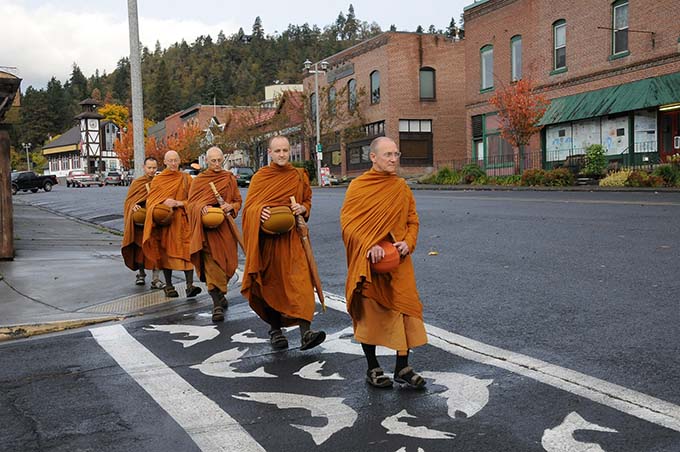
Led by senior monastic Ajahn Passano, monks walk for alms in downtown White Salmon, Washington.
Photos by: Jay Carroll, Bangkok Modern Granite, Alice Hellyar, Carole Melkonian, Benjamin Puggarana, Ajahn Sudanto
Pacific Hermitage, a small Theravada monastery on the Columbia River, is planning housing for esteemed elders of the tradition. This is a final step in the 15-year evolution of the hermitage’s facilities.
Called the Monks’ Retreat House, the new structure will complete the Pacific Hermitage vision of bringing dhamma to small-town Pacific Northwest. Pacific Hermitage is just outside White Salmon, Washington.
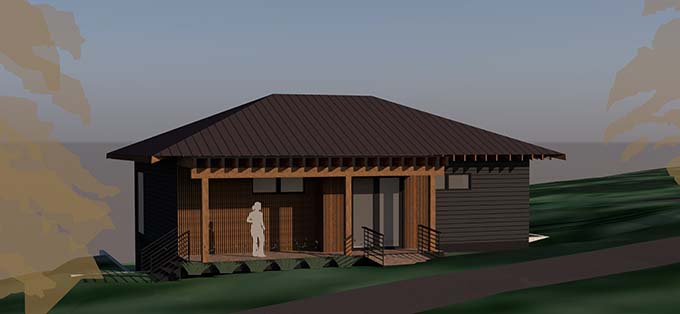
The project is important because the hermitage now is unable to offer housing for elder monastics in Thai forest tradition, such as Luang Por Pasanno and Luang Por Sucitto. Once the Monks’ Retreat House is in place, we will be able to invite these elders to spend extended periods of time with us, right here in White Salmon.
This will give the larger community opportunities to offer alms to these senior monastics, and to engage in dhamma discussions and practice with them, all in the small-town, unstructured way that can actually happen in a place like the hermitage.
The retreat house will be the last major building project the hermitage will undertake. We are hoping to have the project largely funded by 2027, so it may be completed by our 20th anniversary in 2030. While it is a bold goal, the immense value to the community and impact on the sangha make us hopeful we can achieve it.
Architectural plans for the retreat house have been completed, working with a local architect over the past two years. Now everything is in place to move forward with this important project, as soon as sufficient funds have been raised.
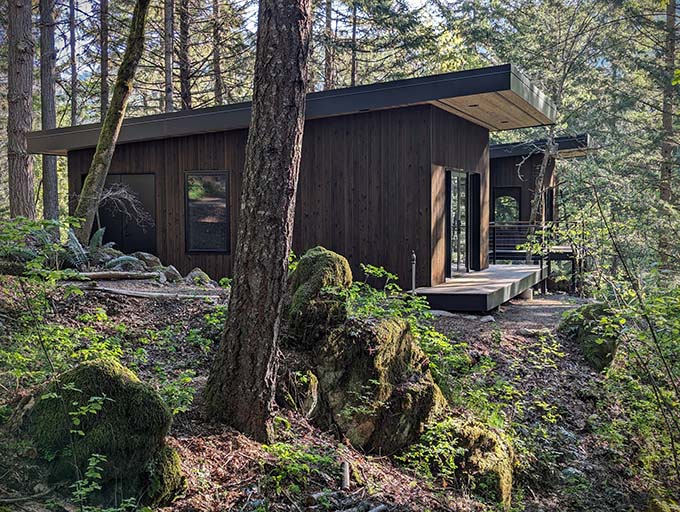
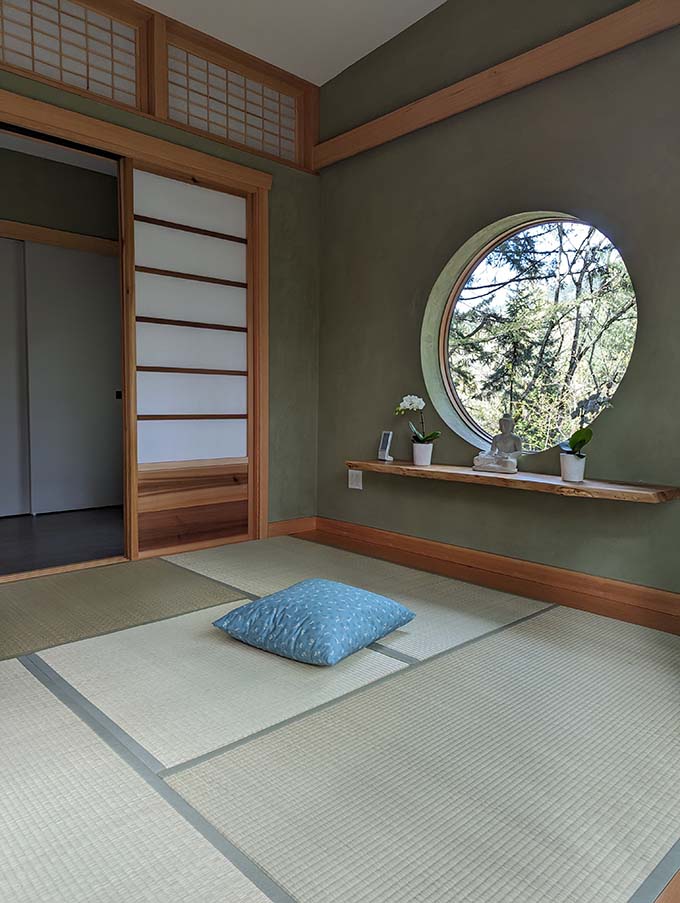
The retreat house will be a multi-use space, but its primary purpose is to suitably accommodate senior monks in our Theravada Thai forest tradition, for visits and periods of solitary retreat. Features of this two-story dwelling will include an accessible sleeping room with a connected bathroom, separate living space for an attendant monk, a kitchenette, and restrooms. It will also have a peaceful meditation and gathering space with expansive views of the forest, which may be used for a variety of occasions.
The majority of the facilities needed for the hermitage were in place from the outset. The largest building project to date was the completion of the abbot’s kuti (cabin) two years ago. Made possible by the generosity of the community, this building was the first major addition to the hermitage, and increased the capacity of the hermitage to four monks.
A New Buddha statue offered
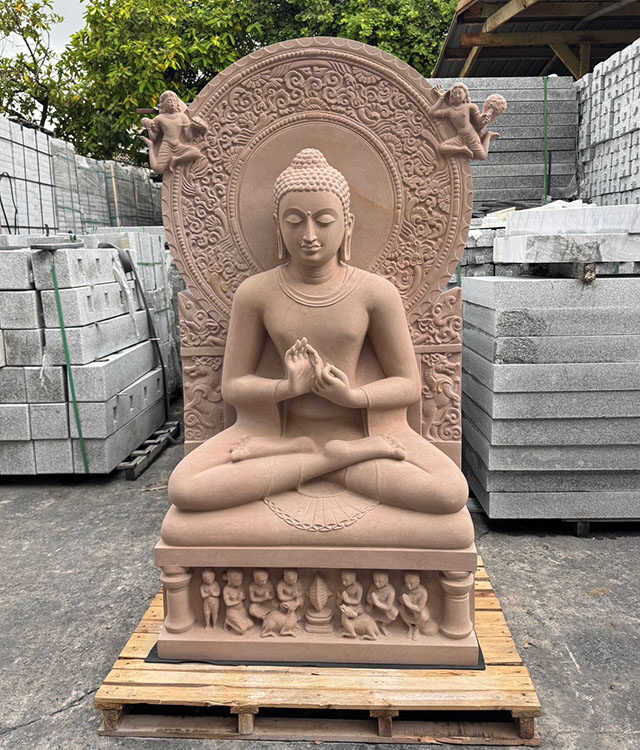
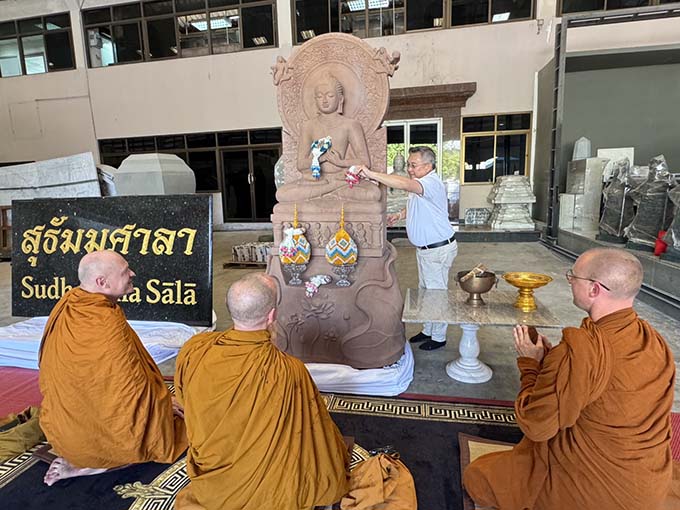
In an auspicious beginning for the retreat house, Pacific Hermitage Abbot Ajahn Sudanto was offered a beautiful Buddha statue and stand for the Monks’ Retreat House, while traveling in Thailand recently. The image is crafted from sandstone, and it depicts the Buddha’s first teaching at Deer Park, in Sarnath, India.
There were many people involved in this beautiful and timely act of generosity. The offering was:
- Coordinated by Ajahn Dhirapañño, vice-abbot of Wat Pah Boonlorm Monastery.
- Sponsored by Phra Luang Por Sutham Sudhammo, abbot of Wat Baan Taad Monastery, along with supporter Dr. Narirat and family.
- Supplemented with a sandstone pedestal base offered by Khun Sirichai and his family, the owners of the factory where it was made.
In another fortunate turn of events, Ajahn Ñyaṇiko, the abbot of Abhayagiri Monastery in Northern California, was in Thailand at the same time. He blessed the Buddha statue, and joined Ajahn Sudanto in visiting the factory where it was made.
What an auspicious way to begin the project!
The Pacific Hermitage
Pacific Hermitage is a branch of Abhayagiri Monastery. Established in 2010, Pacific Hermitage reached its 15-year anniversary this past July. Ajahn Sudanto (Ajahn means teacher) was trained at monasteries in Thailand and at Abhayagiri. He has been a monk for more than 31 years, and has served as abbot at Pacific Hermitage since its inception.
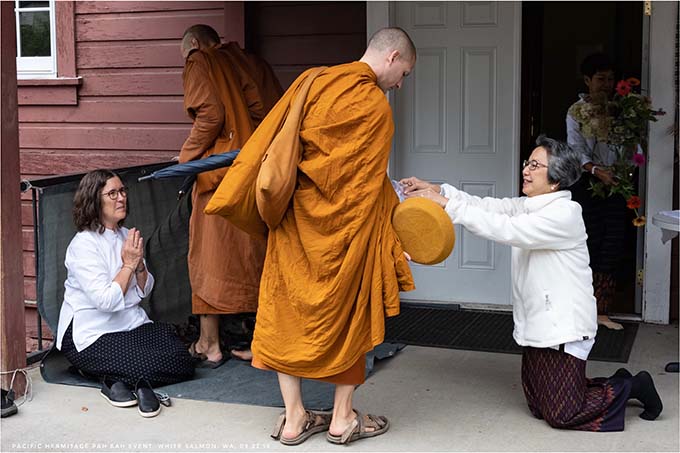
The hermitage is a small monastery intended to be a place of solitude, where a few monks can devote much of their time to meditation, study and simple living. The monks walk daily through the town of White Salmon to accept food offerings for their meal, and to make themselves available as spiritual resources for the community. They offer Buddhist teachings, answer questions, and lead meditation locally and in the region.
The vision has always been for the hermitage to be committed to living and sharing the dhamma locally. The strong roots of the Thai forest tradition, and deep connections with other Ajahn Chah branch monasteries, nourish the dhamma community here in the Pacific Northwest.
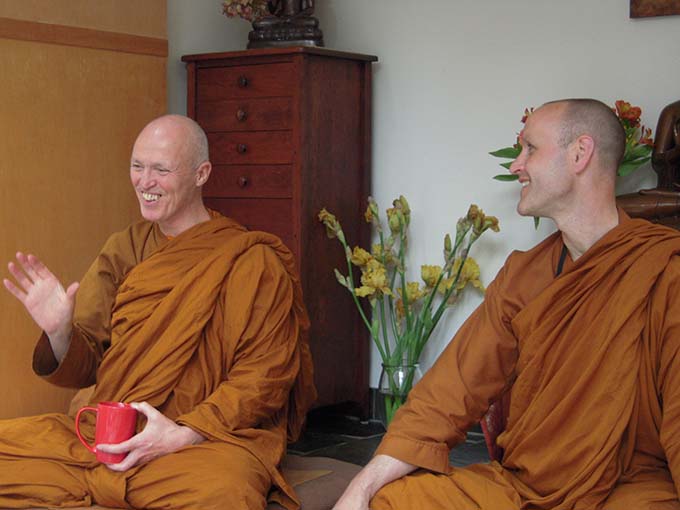
The Thai forest tradition is the branch of Theravada Buddhism in Thailand that most strictly holds the original monastic rules of discipline laid down by the Buddha. The forest tradition also most strongly emphasizes meditative practice, and the realization of enlightenment, as the focuses of monastic life.
Forest monastics live in daily interaction with, and dependence upon, the lay community. While laypeople provide material support such as alms food and cloth for robes for their renunciant life, the monks provide the laity with teachings and spiritual inspiration. Forest monks follow an extensive 227 rules of conduct. They are required to be celibate, to eat only between dawn and noon, and to not handle money.
Fulfilling the vision of the Pacific Hermitage
The ability to bring great dhamma teachers and elders in our tradition here locally, and to offer them the gift of retreat in the unique, serene beauty of the Pacific Northwest – this is our aspiration with the Monks’ Retreat House. We hope the momentum to move this important project forward continues to grow, for the benefit of all beings.
For anyone who is interested in contributing, you can donate through the Sanghata organization that supports the monks (as they do not handle money). You can designate the funds for the project by putting “Monks’ Retreat House” in the comment.
Cāginā Ward began sitting meditation retreats in 2010, and was introduced to monasticism and the Theravada Thai forest tradition via the Pacific Hermitage in 2017. She has been serving the monastic sangha is various ways, including communications responsibilities for the Pacific Hermitage. She has lived at Abhayagiri Buddhist Monastery since July of 2024, and serves as caretaker for the female guest house, among other duties.