
Modern Monastic Life Takes Shape in Oregon:
Founding the Maitripa Rabjungma Community
Written by: Lozang Yönten and Namdrol Miranda Adams
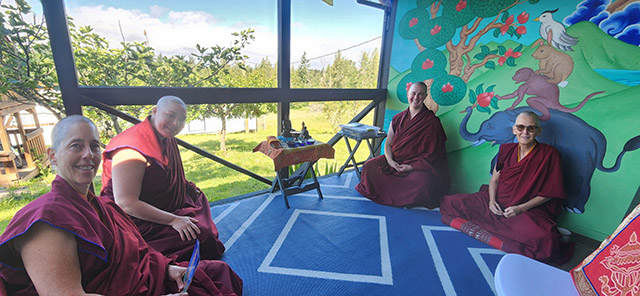
Gompa porch with visiting and resident nuns.
Photos by: Jampa Anderson, Rabjungma Community
by Lozang Yönten and Namdrol Miranda Adams

Portland-based Maitripa College marked a historic milestone in May, by launching its long-anticipated community for monastic Buddhist women: the Maitripa Rabjungma Community.
This inaugural cohort, consisting of three women from the United States and Canada, and their abbess, senior nun Bhikshuni Lozang Yönten, was formally welcomed into monastic life in a ceremony led by the esteemed Geshe Yeshe Thabkhe. The Rabjungma community reflects a deep commitment to supporting the development of the sangha—the ordained community—and to cultivating the inner and outer conditions for spiritual growth.
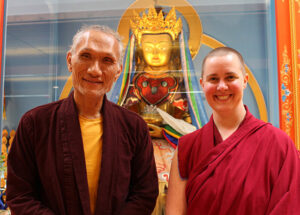
Geshe Yeshe Thabkhe is a senior teacher and monk from Drepung Loseling Monastery, which was originally founded in Tibet, and is now flourishing in exile in India and the United States. The ceremony was facilitated by Maitripa College founding President Yangsi Rinpoche, and by Gala Rinpoche, founder and spiritual director of Drepung Loseling Institute of Texas.
This program, years in the making, reflects Yangsi Rinpoche’s vision of offering in the West, a modern expression of traditional Tibetan Buddhist monasticism.
“We started this project to create a supportive environment through training,” he said, “so the practitioners can benefit and serve the community.”

Maitripa’s initiative seeks to address this by creating a new model of integrated study, practice, and service: one that honors the lineage while adapting to the needs of contemporary Western practitioners.
The new Maitripa Rabjungma Community references the Tibetan word – rabjungma – for junior female monastics at the beginning stages of their training. It is inspired by the spiritual and educational mission of the Foundation for the Preservation of the Mahayana Tradition (FPMT), the international network to which Maitripa College belongs.
The selection process for the first three women began with a two-week retreat held in 2024, designed as a period of deep reflection, shared practice, and discernment. Participants engaged in meditation, philosophical study, and community dialogue, offering both the applicants and the teachers a chance to explore whether this unique path of “hermitage and service” was a suitable fit.
From this retreat three women were invited to continue the process, each bringing a strong foundation of dharma study and practice, a sincere commitment to the monastic path, and a willingness to help shape this new community in its formative years. Their selection reflects both their individual readiness, and their shared aspiration to co-create a life grounded in spiritual depth, simplicity, and service to others.
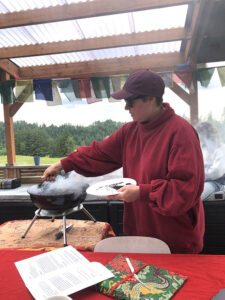
The first cohort of Rabjungma women are currently residing outside Portland, on land offered for the near future through the generosity of a long-time community member. There they are beginning their training in what Rinpoche calls a lifestyle of “hermitage and service.” Daily life of the community is structured around study, prayer and meditation, and mindful and sustainable work on the land.

Their curriculum blends traditional monastic education based on the Tibetan Buddhist tradition of Lama Tsongkhapa—including ritual, meditation, and the study of Buddhist philosophy—with modern training in other modalities. This includes foundational instruction in spiritual care, counseling skills, conflict resolution, and the basics of Tibetan medicine and language. The goal is to cultivate a well-rounded, service-oriented monastic life, grounded in contemplative depth and responsive to the needs of today’s world.
Under the leadership of Venerable Yönten and Yangsi Rinpoche, with the support of an administrative team, the community will grow organically—its path shaped by the intentions of its members and the needs of the larger world it serves. The aspiration is that a natural relationship of mutual respect and support will emerge between the lay and ordained communities, helping to nurture a new generation of practitioners equipped to serve with wisdom, compassion, and resilience.
This is not only the beginning of a new chapter for the nuns themselves, but also a pioneering step toward building a sustainable model of monasticism in the West—rooted in lineage, grounded in community, and open to transformation.
Ven. Yönten is Maitripa Rabjungma Community’s abbess and Maitripa College’s chaplain. She was ordained as a Buddhist nun in 2003 by Khensur Rinpoche, Geshe Tashi Tsering, and with his permission, went on to take full ordination in the Taiwanese Pure Land tradition. She is a registered “In-Depth Teacher” within the Foundation for the Preservation of the Mahayana Tradition (FPMT), and regularly teaches Buddhism and leads retreats at FPMT Centers.
Namdrol Miranda Adams is the dean of education and a founder of Maitripa College. Adams holds a doctorate in education from the University of Portland. Since 1998 she has dedicated her life to the study and practice of the Tibetan language and the Tibetan Buddhist tradition. She has worked extensively with the texts of the tradition as an editor and translator of many publications, has completed the major retreats on the sutra and tantra traditions of the lineage, and was ordained as a Buddhist nun for seven years. Adams is a founding member of the Buddhist Ministry Working Group.