
Historic Bhikkhuni Re-Ordination Reflects
Growing Role of Female Monastics in Washington
Written by: Venerable Sīlānandā Bhikkhunī
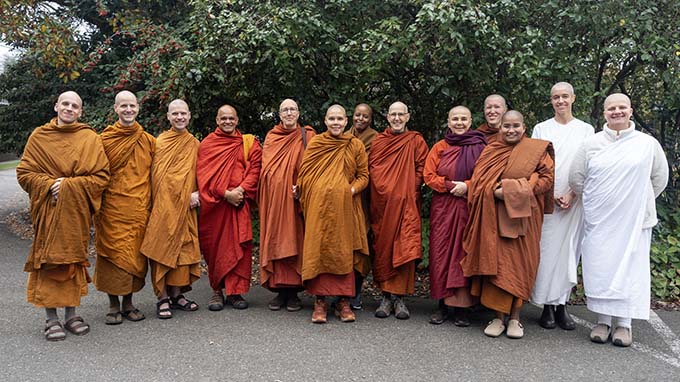
Bhikkhunis and bhikkhus from Washington, Oregon, Oregon, California, Colorado, and Canada participated in the dalhikamma ceremony.
Photos by: Lee Cobert, Chia-Yung Wu
After a break of almost a thousand years in the Theravada monastic lineage, the Bhikkhuni sangha is experiencing a global resurgence, including a small but growing presence in the Pacific Northwest.
Fourteen Buddhist nuns and monks from across the U.S. and Canada gathered in Port Townsend, Washington on November 21, to lead a re-ordination (dalhikamma) ceremony. This ceremony admitted Venerable Silananda into the Theravada monastic community (sangha) as a fully ordained nun (bhikkhuni). Ven. Silananda was previously ordained in a different Buddhist monastic order. This was the first time such a re-ordination ceremony was performed in Washington state.
The ceremony was organized and sponsored by Parayana Vihara, a bhikkhuni community in Port Townsend started in 2024 by senior teacher Ayya Anandabodhi Bhikkhuni. Toward the end of the dalhikamma ceremony Bryanna Raiche, also living at Parayana Vihara, took monastic postulant (anagarika) training precepts to become Anagarika Khema.
Ven. Silananda’s re-ordination ceremony was also the first time that Theravada bhikkhus and bhikkhunis (male and female monastics) came together on Washington state soil to conduct an official sangha rite. The event was certainly a time for celebration, but there was also recognition of work still needed to sustain female Buddhist monastic communities in the U.S. and beyond.
The Dalhikamma Ceremony
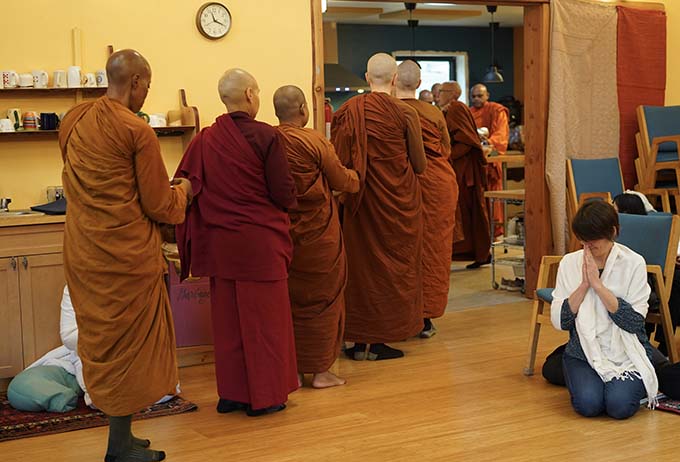
The ceremony began with Ven. Silananda offering candles, flowers, and incense to her preceptor Ayya Anandabodhi and requesting dependence. Two senior bhikkhunis interviewed her to determine her eligibility, which she “passed.” She then three times requested from the bhikkhuni (female) sangha permission to ordain, and through their silence she became ordained “on one side.”
As laid out in the rules of the Vinaya (monastic regulations), Ven. Silananda then requested ordination from the bhikkhu (male) sangha three times, and through their silence she became fully ordained “on both sides.” Elder bhikkhu Bhante Sumitta then instructed her in keeping the monastic precepts, following right livelihood, and practicing ethics, concentration and wisdom.
The entire ceremony was conducted in Pali, and mostly chanted. The ordination space was demarcated by bamboo poles with lights strung between them, with an altar at the front with flowers and a Buddha statue. The monks and nuns sat facing each other across a central aisle, where Ven. Silananda bowed and requested ordination.
Anagarika Khema also took dependence on Ayya Anandabodhi at the end of the ceremony and received the eight anagarika precepts. The anagarika period lasts for approximately one year, at the end of which one can request novice ordination or continue to live as a lay practitioner.
Venerable Thubten Kunga Becomes Venerable Silananda
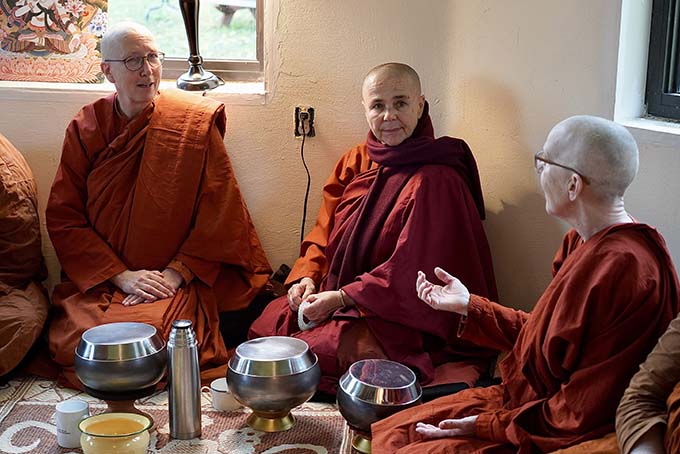
Until she moved to Parayana Vihara in October, Venerable Silananda was part of the monastic community at Sravasti Abbey, a Tibetan Buddhist monastery north of Spokane. Ven. Silananda took novice ordination as Ven. Thubten Kunga in 2019 under Sravasti Abbey founder and abbess Venerable Thubten Chodron Bhikshuni. In 2024 then-Ven. Kunga traveled to Taiwan with four other abbey nuns, to receive full ordination alongside approximately 300 other monastic candidates.
Speaking of her experience at Sravasti Abbey as a junior nun, Ven. Silananda said, “The monastic training at the abbey is unmatched in quality and depth. There are so few opportunities for Western nuns to receive thorough training, guidance, and support while living in a thriving monastic community. The abbey provided all the material support, resources, and loving-kindness I needed to become a proper monastic. I am so thankful to the abbey for exemplifying the critical role that monasticism plays in rooting the Buddha’s teachings (dhamma) in Western society. “
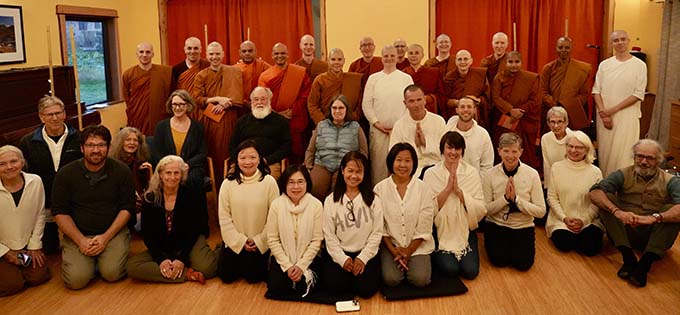
Ven. Silananda’s re-ordination ceremony offered a joyful occasion for the gathering of 14 Theravada monastics from up and down the West Coast, as well as from New Jersey and Alberta, Canada. Ayya Anandabodhi served as Ven. Silananda’s ordaining preceptor, while Bhante Nivitigala Sumitta Thero, a senior bhikkhu from Sri Lanka who leads the organization Dhamma USA based in California, served as the presiding elder bhikkhu.
The two senior instructors (acaryinis) on the bhikkhunis’ side included Ayya Suvijjana of Passaddhi Vihara in Olympia, Washington, and Ayya Santacitta, who currently stewards the Aloka Earth Room near San Francisco. This latter initiative aims to restore human connection to the Earth using art and ecology, combined with Buddhist teachings and meditation.
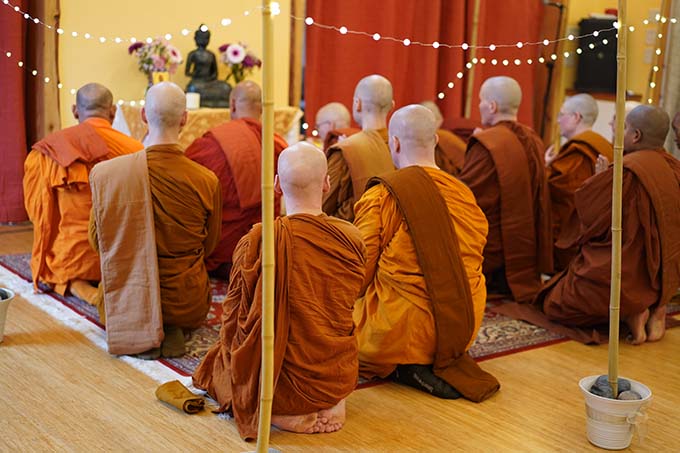
The two senior instructors on the bhikkhus’ side (acaryas) included Ajahn Kovilo of Clear Mountain Monastery, and Bhante Jayasara of the MaggaSekha project.
The ordaining bhikkhuni sangha also included Ven. Satima of Parayana Vihara, Ayya Niyyanika of Passaddhi Vihara, Ayya Ahimsa of Canmore Theravada Buddhist Centre in Alberta, Canada, and Venerables Kaccayana and Vandana from Dhammadharini Monastery in Penngrove, California. Under the instruction of Dhammadharini abbess and elder Bhikkhuni Ayya Tathaloka Theri, venerables Kaccayana and Vandana provided technical guidance to ensure the ceremony abided by the requirements laid out in the Vinaya for a valid ordination to take place. This included creating a boundary (sima) around the ordination site.
The ordaining bhikkhu sangha included Ajahn Nisabho of the Clear Mountain Monastery, Bhante Ariyakiththi of the Sarana International Buddhist Center in Tukwila, Washington, and Tejassi Bhikkhu, who leads the Heart-Path Dhamma Community.
Some of the ordaining monastics had known each other for over 30 years, while some were meeting for the first time. The occasion was particularly rich because the monastic community is still coalescing in the Pacific Northwest, and there is a wish to become more interconnected to better support one another.
What is Buddhist Monasticism?
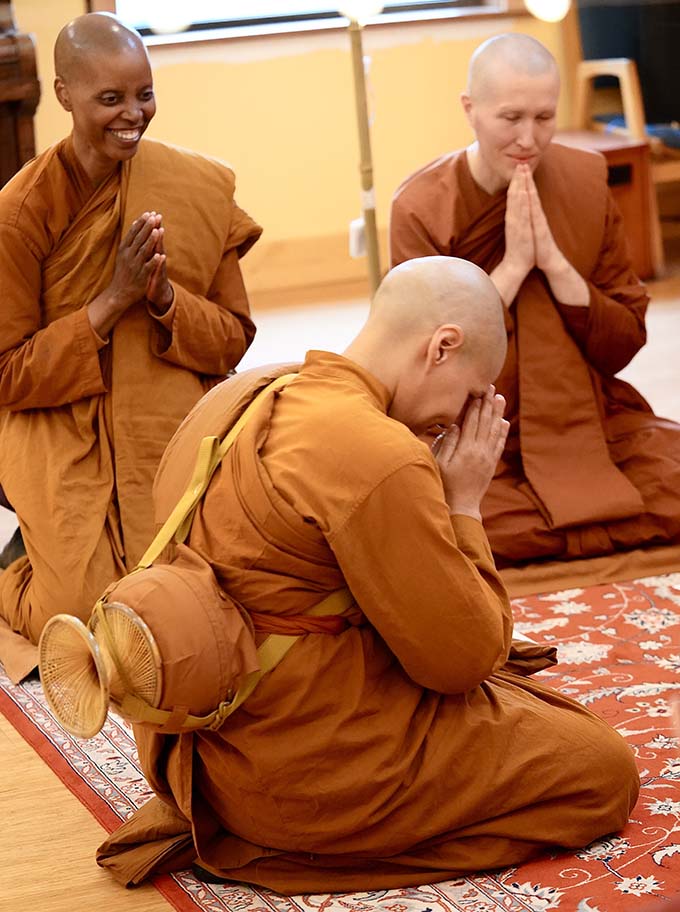
Despite the growth of Buddhism in the U.S., monastic communities remain quite rare. Buddhist monasticism is one of the oldest institutions in the world, dating back approximately 2,600 years to the time of the historical Buddha Sakyamuni. Monasticism is defined by its heightened degrees of ethical discipline, sense restraint – including celibacy – and cultivation of positive qualities such as contentment, loving-kindness, and wisdom.
In the Theravada monastic order, bhikkhunis observe 311 training rules (precepts), while bhikkhus observe 227. The precepts center around non-harmfulness and right livelihood, and monastics confess their transgressions and restore their observance of the precepts on a fortnightly basis.
At the time of the dalhikamma ceremony, Ven. Silananda was already a fully ordained nun in the Dharmaguptaka monastic tradition, which is observed in East Asian Buddhist countries such as Korea, China, Taiwan and parts of Vietnam. The Dharmaguptaka lineage is the only one of the three existing monastic traditions that managed to preserve an unbroken line of fully ordained nuns all the way back to the time of the Buddha. The bhikkhuni order in the Theravada tradition died out in the 11th Century, and full ordination for nuns in the Mulasravastivada tradition practiced in the Himalayan regions of Asia never became widespread.
The Restoration of the Theravada Bhikkhuni Lineage
An international movement began toward the end of the 20th century to restore full ordination for nuns in the Theravada order, and after much effort, bhikkhuni ordination was reintroduced in 1996 with help from monastics in the Dharmaguptaka lineage. The number of bhikkhunis around the world has steadily increased since then, and Ven. Silananda’s addition was a welcome contribution to the bhikkhuni sangha in the Pacific Northwest.
The greater Seattle area is home to two bhikkhuni communities: Passaddhi Vihara in Olympia, led by Ayya Suvijjana Bhikkhuni and Ayya Niyyanika Bhikkhuni, and Parayana Vihara, led by Ayya Anandabodhi Bhikkhuni, where Ven. Silananda resides.
Ayya Anandabodhi was previously co-founder and co-abbess of Aloka Vihara Forest Monastery in Placerville, California, which closed in 2022 due to wildfire damage. Based out of Seattle is Clear Mountain Monastery led by Ajahn Nisabho and Ajahn Kovilo, two bhikkhus in the Theravada Thai forest tradition.
Monastic candidates typically spend one year as a postulant (anagarika) in which they contemplate their aspiration while observing additional ethical precepts, shaving their head, and wearing a white robe. If the aspirant is deemed suitable, a fully ordained monastic performs an ordination ceremony to admit them as a novice, which lasts for a period of two years. A bhikkhuni ordination ceremony marks the full entry of a candidate into the Buddhist monastic order, and requires the participation of at least five bhikkhunis and five fully ordained bhikkhus.
Why Change Monastic Traditions?
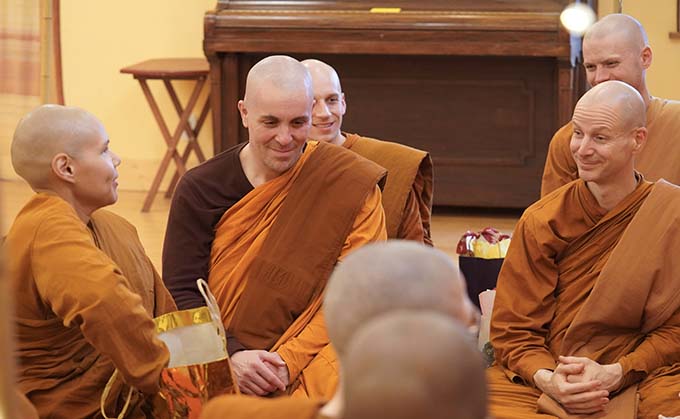
Explaining why she decided to change to the Theravada monastic tradition, Ven. Silananda said,
“I have tried to live my life devoted to exploration and learning. As a lay Buddhist, I read books from all the major traditions and wished to understand them all as best as I could. When I first set out down the monastic path, finding a stable monastic community with good leadership, strong ethics, and holistic training that would prepare me to take full ordination as a bhikkhuni was the most important thing. Which Buddhist tradition to follow was secondary, in a sense.
“The depth and breadth of the Vajrayana Buddhist tradition is vast and profound. I was drawn to the joy, ease, and warmth that Tibetan monastics exude, sensing a need to develop them within myself. Thankfully, these qualities are by no means unique to Vajrayana practitioners, and I live in a Theravada community where these qualities are also at the forefront.
“The Theravada tradition was the first one I encountered in this life, and I have no doubt about the efficaciousness of its presentation of the spiritual path and fruit. I feel as if I am hearing the voice of the Buddha directly when reading the Pali suttas, and his fundamental teachings of the four noble truths and eightfold noble path contain all I need to make sense of my human condition.
“Sravasti Abbey provided me with everything I needed, and more, to become a well-trained monastic and experience the countless benefits of community life. However, over time, I sensed a strong need to return to my Theravada roots to continue deepening my renunciation, concentration, and understanding of the dhamma.”
The Path Forward
To some extent, the bhikkhus who participated in the ceremony are still outliers in openly supporting bhikkhuni ordination. Ajahn Nisabho of Clear Mountain Monastery said at an almsgiving ceremony for the bhikkhunis the following week,
“One of the most affirming elements of coming to the Northwest and feeling like we’re doing something that’s… deeply meaningful has been seeing these bhikkhuni communities and our bhikkhuni siblings come nearby, and we feel just so heartened and encouraged and held in this kind of growing family and constellation of goodness.”
He added, “I can think of only one other place in the world right now – maybe Western Australia – where there’s this constant and growing friendship and union between the Theravada bhikkhus and bhikkhunis, and we feel so honored to be a part of that.”
Ven. Silananda believes this is a potent and auspicious time for bhikkhunis. She said,
“There is more and more awareness of the exclusion that women have historically faced in Buddhist monastic institutions, and also a growing recognition of the need to support the bhikkhuni sangha if Buddhism is to flourish in the 21st century.”
Venerable Sīlānandā Bhikkhunī began her monastic life practicing within the Tibetan Buddhist tradition at Sravasti Abbey near Spokane. She received novice ordination as Ven. Thubten Kunga under Ven. Thubten Chodron Bhikshuni in 2019, and full ordination under Venerable Master Wuyin in Taichung City, Taiwan in 2024.
In November 2025, Ayya Ānandabodhī ordained Ven. Sīlānandā Bhikkhunī into the Theravada monastic lineage, with Bhante Nivitigala Sumitta Maha Thero serving as the presiding monk elder. Venerable Silananda currently assists with communications and administration at Parāyana Vihāra.