
Friends of the Dhamma Steps Forward at 25 Years
Written by: Jessica Swanson
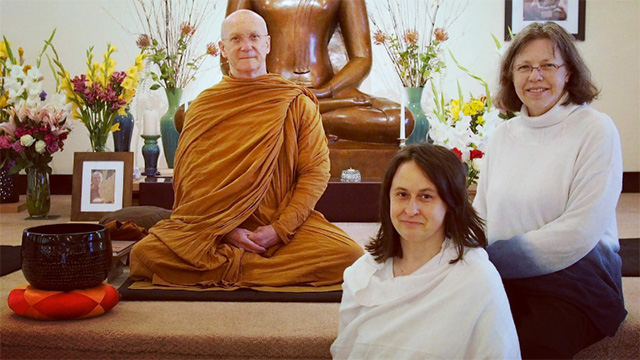
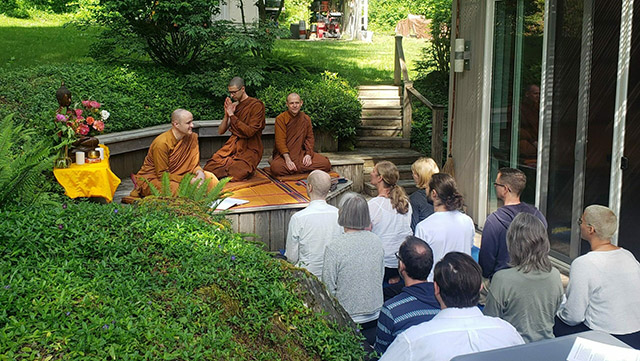
As a senior monastic in Ajahn Chah tradition, Ajahn Passano was present during the ceremony conferring leadership to Jessica Swanson.
As it celebrates its 25th anniversary, Portland Friends of the Dhamma is moving ahead with new leadership, and new offerings in the realm of Theravāda Buddhist teachings and practice.
Founded in 2000 by Sakula Mary Reinard, Portland Friends of the Dhamma (PFOD) began with a simple but profound intention: to bring Western monastics of the Ajahn Chah lineage to Portland, and to share the dhamma and meditation with those drawn to the Thai forest tradition—an ancient monastic lineage linked back to the time of the Buddha.
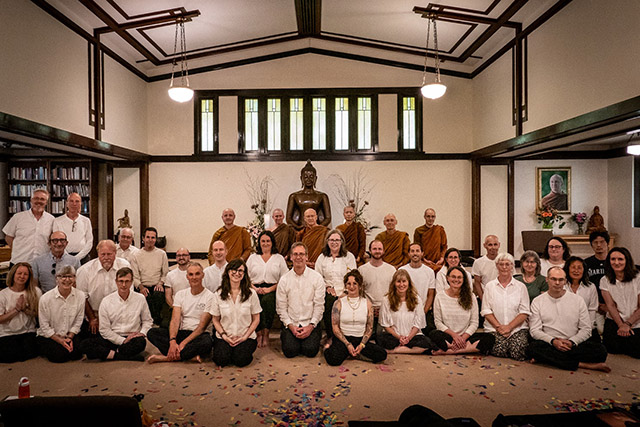
PFOD in the Present Moment
In June 2024, Jessica Swanson succeeded Reinard, generally known as Sakula, as spiritual director of PFOD. This transition came after three years of mentorship and training, and more than 20 years of practice in the lineage. This leadership transition marks a new chapter in PFOD’s evolution.
Sakula was an ordained lay minister through an Abhayagiri Buddhist Monastery training program that no longer exists. In order to create an equitable position for Swanson, the community underwent a lengthy and formal process to commission her as a lay minister, with the privileges and responsibilities associated with a clergy post.
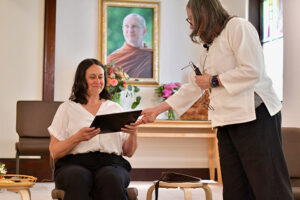
As spiritual director, Swanson has a keen interest in offering new and refreshed programs while deepening the bench of dedicated practitioners who are equipped and supported to lead them. She also holds office hours two days a week to meet with community members about practice and PFOD.
True to the spirit of spontaneity in the Thai forest tradition, anyone can sign up for office hours using a link with just an hour’s notice. Swanson finds that being responsive to community needs as they unfold, and even “scheduling in” uncertainty, has become a key part of her practice.
Today, PFOD offers programming seven days a week, and serves more than 100 people weekly. Several new programs and community offerings have launched just since January:
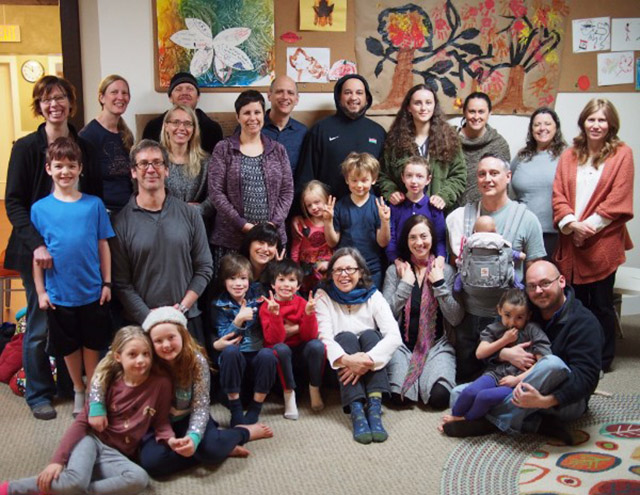
- Children’s Program: A revived children’s offering during Sunday Sila officially launched in January 2025 and was immediately met with enthusiasm—one child turned into six on the first day. This program continues to take shape, with parent and volunteer support.
- Morning Meditations: Launched in early January, this weekday drop-in silent meditation and fellowship has attracted new participants each week, many of whom have become members of the larger community. This offering is anchored by a different dedicated practitioner at 7 a.m. each morning on Mondays, Tuesdays, Thursdays, and Fridays.
- Wednesday Night Sit & Share: This new midweek community meditation and discussion format began in the spring, led by a team of lay Buddhist practitioners called upasikas. These events are modeled after PFOD’s original format, and are quickly becoming a pillar of the organization’s weekly programming.
Continuing programs include:
- Sunday Sila – A Sunday morning program led by Jessica, featuring meditation, Dhamma reflection, and community gathering.
- Investigations – A long-standing Friday night sutta study led by Matthew Grad (a former Spirit Rock teacher), Ruby Grad, and Heather Fercho.
- Virtually Bookish – An online book group held two Saturdays a month, focused on contemporary Dhamma texts, led by Ruby Grad.
- Monday Night Classes – Rotating introductions to foundational topics like meditation, the five precepts, and Buddhist basics.
- The Upasika Program – A two-year training for lay practitioners living by the five precepts and drawing close to the Ajahn Chah monastic lineage. The curriculum includes the noble eightfold path, the 10 pāramīs, and the etiquette of supporting monastics.
Monastic Guests: The Heart of the Community
At the heart of PFOD’s calendar are its monthly visits from monastic teachers. The community continuously requests more contact with Theravāda nuns, and this year PFOD will welcome five bhikkhunīs. The five will be Ayyā Santussikā and Ayyā Cittānandā from Karuna Buddhist Vihara, Ayyā Suvijjānā and Ayyā Niyyānika from Passaddhi Vihara, and Ayyā Medhānandī (virtually) from Sati Sārāṇīya Hermitage.
PFOD is also nurturing a newly formed relationship with Clear Mountain Monastery in Seattle, hosting ajahns Kovilo and Nisabho for a visit last fall, and again this December.
Over the years, PFOD has hosted senior monks and nuns from around the world, including Ajahn Liem, Ajahn Chah’s successor in Thailand; and Ajahn Sumedho, the lineage’s most esteemed Western elder. Ajahn Geoff (Thanissaro Bhikkhu) will return in October, and Pacific Hermitage Abbot Ajahn Sudanto continues to offer regular teachings, as do visiting monastics from Abhayagiri Monastery in California.
An urban refuge in changing times
PFOD purchased its current home in 2014, acquiring the former Dharma Rain Zen Center in Southeast Portland. True to the spirit of mutual support, PFOD rents space to other Buddhist and meditation groups, helping incubate new communities and ease financial burdens, just as Dharma Rain did.
The historic two-story, 3,500-square-foot building is located in inner Southeast Portland. The upper floor contains a large meditation hall (sala) with an elevated altar, a restroom and a cloak room. The five-foot Buddha statue anchoring the space was a gift from Abhayagiri Monastery, and was crafted in Thailand.
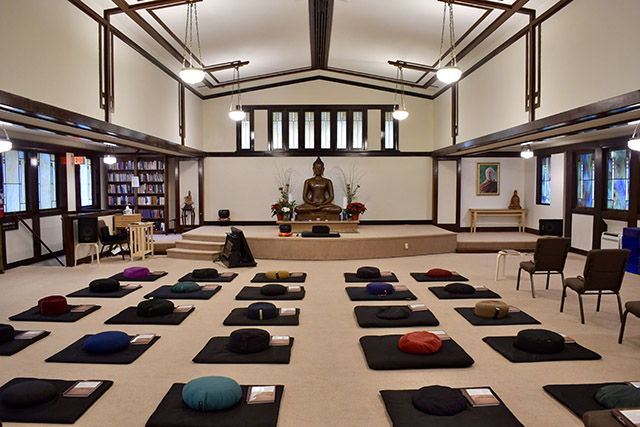
The daylight basement features a community gathering space that includes a children’s area, full kitchen, dining area, library, two offices, two bathrooms and a 250-square-foot commercial office for lease. Groups who rent weekly or for special events have access to the entire building, and to all the amenities available to PFOD members.
The pandemic in 2020 brought disruption, but the center quickly adapted thanks to audio-visual upgrades by Sakula’s husband and dedicated practitioner, Alistair Williamson. Online programs sustained the community, and tenants remained faithful through uncertain times.
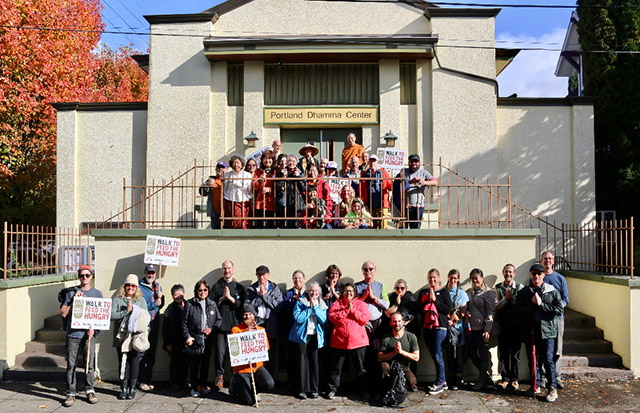
In 2024, long-time tenant No Rank Zendo moved into its own space—a sign of their growth within the Portland Dhamma Center. In 2025, due to broader economic strain, PFOD said goodbye to another dhamma tenant and to its commercial renter.
While PFOD never charges for its teachings, events, or spiritual care—in keeping with the Theravāda tradition—the organization does rely on rental income from its building to remain sustainable. The Portland Dhamma Center now offers space on weekday evenings and Saturdays to like-minded groups, and has one commercial office suite available for rent.
Roots in the Thai Forest Tradition

PFOD is part of the global Ajahn Chah lineage, a network of over 300 monasteries in more than 10 countries. Its origin lies in the life and practice of Venerable Ajahn Chah (1918–1992), who ordained in Thailand at age 20.
Westerners were drawn to Ajahn Chah’s simple, accessible teaching style. In 1967, Ajahn Sumedho became his first Western disciple to stay long-term. By 1975 Ajahn Chah had asked Ajahn Sumedho to establish Wat Pah Nanachat, an international monastery for non-Thais, located about six miles from Ajahn Chah’s Wat Pah Pong.
Soon after, during a visit to England, Ajahn Chah saw the potential for a Western monastic presence. A chance encounter during an alms round led to the donation of 108 acres of woodland in southern England—now home to Cittaviveka (Chithurst Monastery). The Western monastic community has since flourished, with Amaravati Monastery in England as its hub, and monasteries established across Europe, Australasia, and the Americas.
In 1995, Abhayagiri Monastery was founded in Northern California under the guidance of Ajahn Pasanno and Ajahn Amaro. It was from this center that PFOD took root.
Laying the Foundation in Portland
Inspired by Ajahn Pasanno’s guidance to “lay the foundation,” Sakula began the work of building a lay community in Portland. She trained under Ajahn Pasanno and Ajahn Amaro in the newly established Community of Abhayagiri Lay Ministers program, completing her training in 2004.
PFOD officially became a non-profit organization in 2005, with the long-term goal of establishing a monastic hermitage. That vision came to fruition in 2010 with the founding of the Pacific Hermitage in White Salmon, Wash. Ajahn Sudanto has served as its senior monk from the beginning, and the hermitage celebrates 15 years this fall.
A Constant on the Path
As Portland Friends of the Dhamma reflects on its first 25 years, it remains rooted in the Buddha’s teachings while navigating the realities of modern life. Despite uncertainty—a constant on the path—the presence of sincere practitioners brings light, refuge, and clarity to the world.
Jessica Swanson is a Theravada Buddhist meditator in the lineage of Luang Por Chah and Abhayagiri Buddhist Monastery, in training since 2003. In 2024 Swanson was commissioned as a minister in the lineage, and became spiritual director of Portland Friends of the Dhamma. She leads Sunday Sila, directs programming, and teaches several meditation and Buddhism classes. Swanson is also a board officer of the Sanghata Foundation, the stewarding organization of the Pacific Hermitage, an Abhayagiri branch monastery in White Salmon, Wash., which she helped found.