
A Unique Northwest Book on Committed Practice
Written by: Tendo
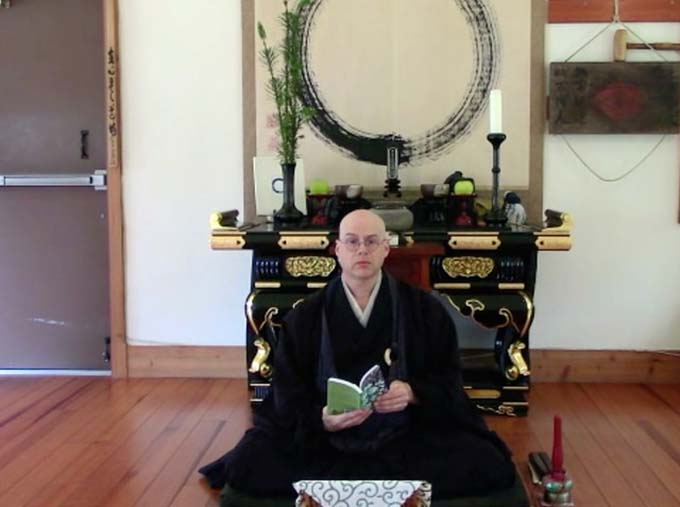
Tendo Zenji, book in hand, before the Zen altar.
Photos by: Tendo, Andrew Woods
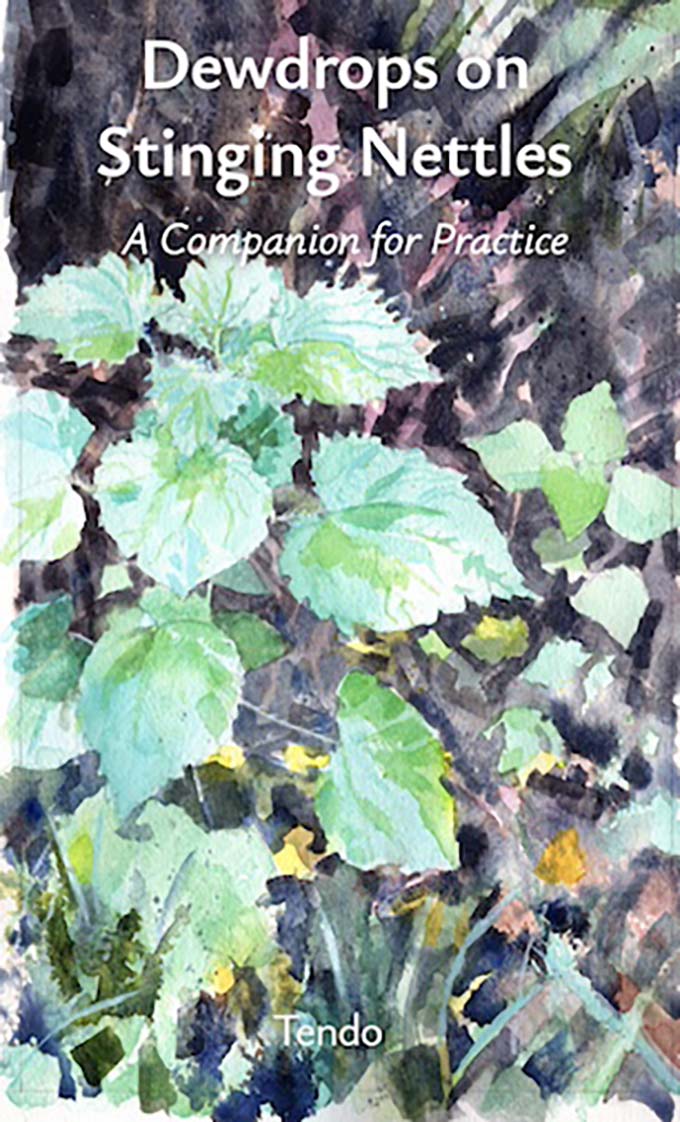
The book “Dewdrops on Stinging Nettles: A Companion for Practice,” released in June, shows a way to a life of fiercely committed dharma practice.
This revised and expanded edition of the book presents a complete program of practice organized around groups of individual methods. Grounded in essential principle, it directly lays out a complete body of practices for transforming our lives, oriented toward encountering reality as is.
“Dewdrops on Stinging Nettles” was created by Tendo, who has been an active investigator into the essential questions throughout his life. An ordained Rinzai Zen monk, he has dedicated his life to practice and the sharing of practice with others. Since 2018 he has been the head monk at Tahoma Zen Monastery on Whidbey Island, northwest of Seattle. However the book is his own, and is not affiliated with the monastery.
This is a new book filled with a variety of practices and how to adapt them to one’s circumstances. It emphasizes the necessity of commitment, of working deeply with an individual method, to not take an àla carte approach to practice. At the same time its central orientation acknowledges the unique path that each of us treads upon.
Regardless of how rigorously any given method is presented, all practitioners have to find their own way to embody it. In the practices in “Dewdrops on Stinging Nettles,” this is taken as the basic understanding for each of the techniques presented.
– The Editors
“What is True, and, How Then do we Live?”
(By book author Tendo)
Such is our nature, that coming to a resolution of these questions is a necessary part of our lives. For many, they are satisfied with the answers given to them from tradition. For others, resolving this matter will be something they put off until they reach an existential crisis that forces the issue. Many more will attempt to just live with the vague sense of unease engendered by ignoring these issues. But for some, finding the answers to these questions is the burning issue of their lives. The great practice traditions implore us to see it for ourselves, to commit ourselves wholly to the investigation, to throughly resolve these questions.
We labor under the delusion that what we truly are is an individual and separate self, and thus too often, those engaged in the search for what is true do so under the auspices of the self attempting to reify and aggrandize self. The self tells us that we can have it all: We can engage in practice but also in all aspects of everyday life. But in this way we do not fully commit to either.
This delusion has become so pervasive that more often than not, even when one formally dedicates one’s life to the quest for the truth, it is just a part-time endeavor. Because of this, regardless of intentions or commitments, one never truly devotes their life to the way.
“The absolute root of our practice is commitment. Commitment, to constantly return our attention to the practice, commitment to bringing our practice into lived experience, commitment to not increasing the suffering in the world, and commitment to responding as circumstances demand. Therefore we engage in the practice in every activity, wherever we are, 24 hours a day.” p. 16
History and tradition are clear that only way to truly clarify this great matter, to be rid of all traces of the self and thus able to truly help all beings, is for one’s commitment to be total.
If one has truly aroused Wayseeking Mind, that orientation to resolving this matter of what is true, not for self-aggrandizement, but for the sake of all beings, then how is one to proceed? In the circumstances of modernity it is difficult to live a life fully committed to practice, because there is little support for it and few who actually embody the Truth. It has always been the case that it is incumbent upon the student to find genuine teachings, good friends, and true centers of training. This is even more essential and more difficult than ever. One answer is to make our very lives a training environment, so that all of our endeavors are practice, and all facilitate our investigation into this great matter
“The Dream Mountain Way is a pragmatic, hands-on approach to continuous practice. In our daily lives, on pilgrimage, in solitude, on retreat, amidst all activity–in every circumstance, everything is an opportunity for practice. We must strive to not limit ourselves to any particular modality. It is the circumstances that arise in every domain that we must respond to and that is the most essential practice. We take every opportunity, every moment, as a good friend, pointing at the way, illuminating where there is work to be done, endlessly murmuring ‘not yet,’ ‘not yet.,” (p. 115)
The Dream Mountain Way is oriented around the understanding that everyone’s path is unique, and yet to try to just find one’s own way is fraught with peril. This is an approach of continuous practice, where every person, every encounter, everything that we see and hear and do is a teacher. It is oriented around stillness, openness and investigation, and offers a wide variety of tools designed to work with all minds, wherever they are at. It is an approach that integrates well with other traditions, fleshing out what might be a more limited form of practice, allowing one to engage in truly full-time, committed practice.
Likewise, the necessity for balancing the individual nature of practice along with working with others is a core understanding. We are all called on to be good friends, who can share practice with others just as we rely on our good friends to help us when we are in need. The body of practices presented is rife with examples of where we work with others, and how engaging in helping as we can is vital to genuine awakening.

“When we stop and let things go and open up our senses, we are practicing maintaining that functioning without the filtering of our conditioned responses. We are training ourselves to remain in openness. Gazing is practicing seeing the world as it truly is, being fully open to what is”. p. 52
Uniquely among practice systems, the Dream Mountain Way utilizes all diverse features of our environment as part of the training. Investigating those hinge points where we grasp a false sense of separateness embedded in our very senses, the Dream Mountain Way utilizes what we can see, hear, feel and think as sites of practice. With this body of methods, whatever we may encounter as we move through the world is a place of training, transforming our every moment into practice. In this way we able to engage in continuous practice.
When we have aroused the aspiration for awakening, to genuinely resolve for ourselves the essential questions of “What is true,” and “How then do we live,” we must devote ourselves single-mindedly to the investigation. There are countless options on offer, but all too often they fall far short of what is required. The Dream Mountain Way begins with the need for fully engaged practice and acknowledges and directly works with the circumstances of our lives. With “Dewdrops on Stinging Nettles” we have a guide, indeed a companion, for how to make our very lives a place of practice.
For more information on “Dewdrops on Stinging Nettles: A Companion For Practice” please see its page on the Dream Mountain site: Dewdrops on Stinging Nettles. For more of Tendo’s writings on practice and other topics, see his practice blog Drafty Mountain Hut.
If you appreciate our work, consider a donation.
Tendo has been an active investigator into the essential questions throughout his life. An ordained Rinzai Zen monk he has dedicated his life to practice and the sharing of practice with others. Since 2018 he has been the head monk at Tahoma Zen Monastery. As one dedicated toward helping others with practice he has lead retreats, taught technique, given talks and produced numerous writings in essays, newsletters and on the web at Drafty Mountain Hut. His books include “Dewdrops on Stinging Nettles: A Companion For Practice,” and the forthcoming “Raindrops on Still Water: Poems for Practice.”