
Ven. Dharmamitra’s Bodhisattva Path Translations
Written by: Bhikshu Dharmamitra and Richard Hill
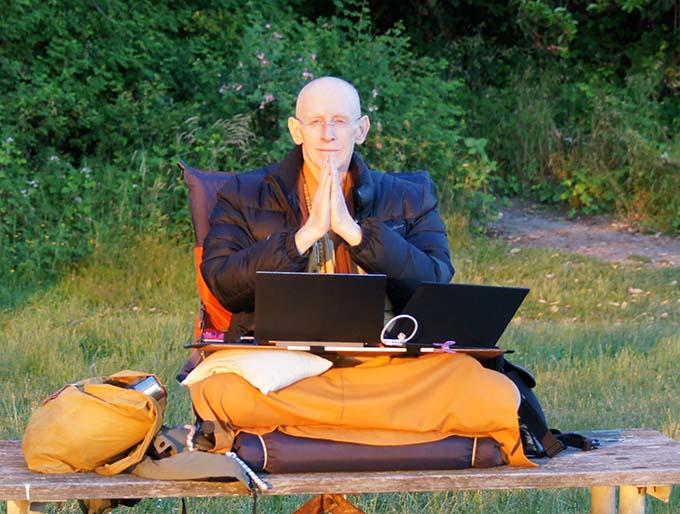
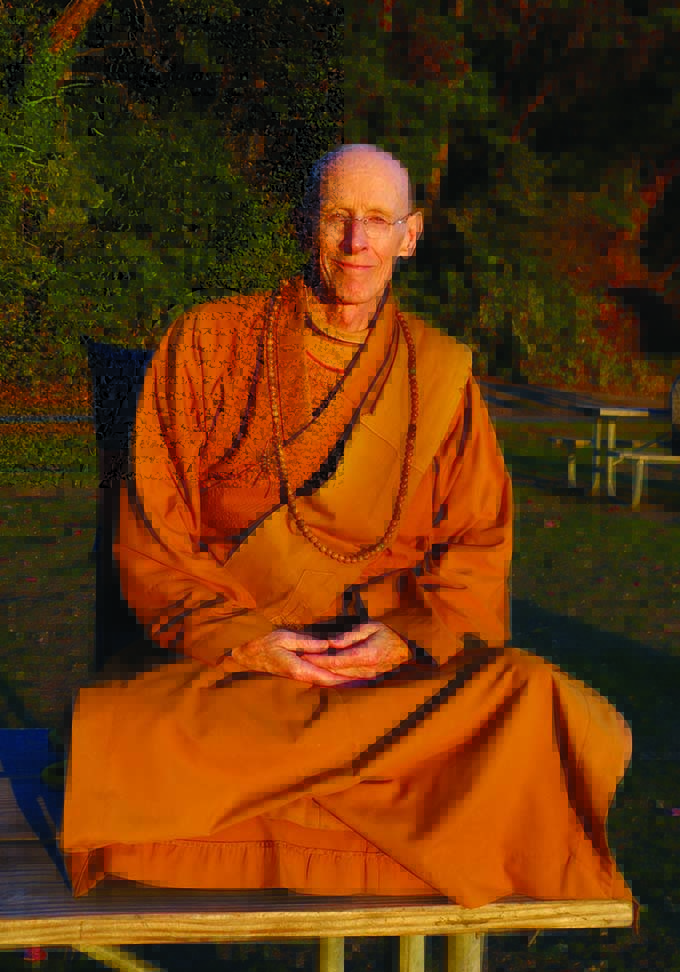
Bhikshu Dharmamitra often does his translating on a bench in Seattle’s Lincoln Park, overlooking Puget Sound.
Photos by: Dharma Realm Buddhist Association, John McKlosky
Bhikshu Dharmamitra, a Seattle-based Chinese-tradition translator monk, is just finishing his 17th book of translations. Now 77, Dharmamitra continues to focus on making available in English, precious works of dharma by great historic Buddhist masters.
For the last 25 years Bhikshu Dharmamitra has been translating and publishing his translations of classic Indian and Chinese Mahāyāna sutras, treatises, and commentaries through Kalavinka Press, which he founded. He works out of a small West Seattle temple house known as the Bodhi Dhamma Center. This house was generously lent to him as a translation studio by Dharma Realm Buddhist Association, which was created decades ago by his spiritual mentor Venerable Chan Master Hsuan Hua.
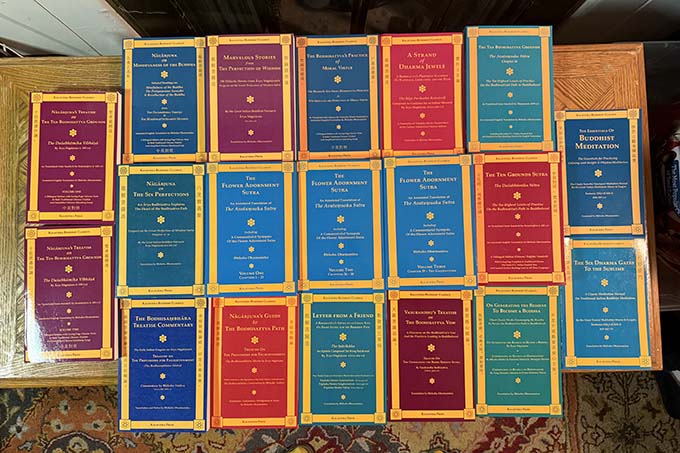
Dharmamitra is currently putting the finishing touches on his 17th book of translations, Selected Teachings of Hanshan Deqing. This consists of important works by one of the four great monks of the Ming Dynasty.
Richard Hill, a Northwest Dharma News contributor, met with Dharmamitra on a sunny autumn afternoon in West Seattle’s Lincoln Park, on the shores of Puget Sound. Dharmamitra can be found there most afternoons in decent weather, on a park bench near Colman Pool, wearing his monk’s robes, sitting in lotus with a laptop and extra monitor on his lap, busy with his ongoing translations from a very difficult and esoteric scriptural language known as “Sino-Buddhist Classical Chinese.”
In our conversation, I asked Dharmamitra what he understands to be his purpose in life.
“My purpose,” he told me, “My raison d’être so to speak, is to be able to offer ‘right dharma teachings’ to the Buddhist community by making available in English never-before-translated sutras, meditation texts, treatises, and commentaries from such well-known Indian Mahāyāna authors as Nāgārjuna and Vasubandhu, as well as by their most highly regarded Chinese Buddhist counterparts.” He added, “These writers set forth clearly and beautifully the essence and most important details of the doctrine and practice of the bodhisattva’s path to buddhahood.”
All of Dharmamitra’s translations are available as high-quality perfect-bound books from Amazon, Barnes & Noble, and nearly all other major book sellers. In addition, as a gift to dharma students worldwide, Dharmamitra now offers all of his translations for free as high-quality pdf e-books, downloadable from his Kalavinkapress.org website.
What’s more, insofar as resources allow, his Kalavinka Press also donates complete sets of all of his translations as hard-copy books to whichever university, public, or large monastery libraries request them, in accordance with the details outlined on the Kalavinka Press website. In these ways his translations have been widely circulated not only in the United States, but also increasingly in China, Taiwan, Vietnam, Korea, India and Europe.
Selected Teachings of Hanshan Deqing is to be published in early 2026. This work consists of Chan Master Hanshan Deqing’s short commentaries on the Heart Sutra and Diamond Sutra. It also includes his teachings on topics such as Chan meditation, the four bodhisattva vows, the Pure Land dharma gateway, and the operation of karmic cause and effect.
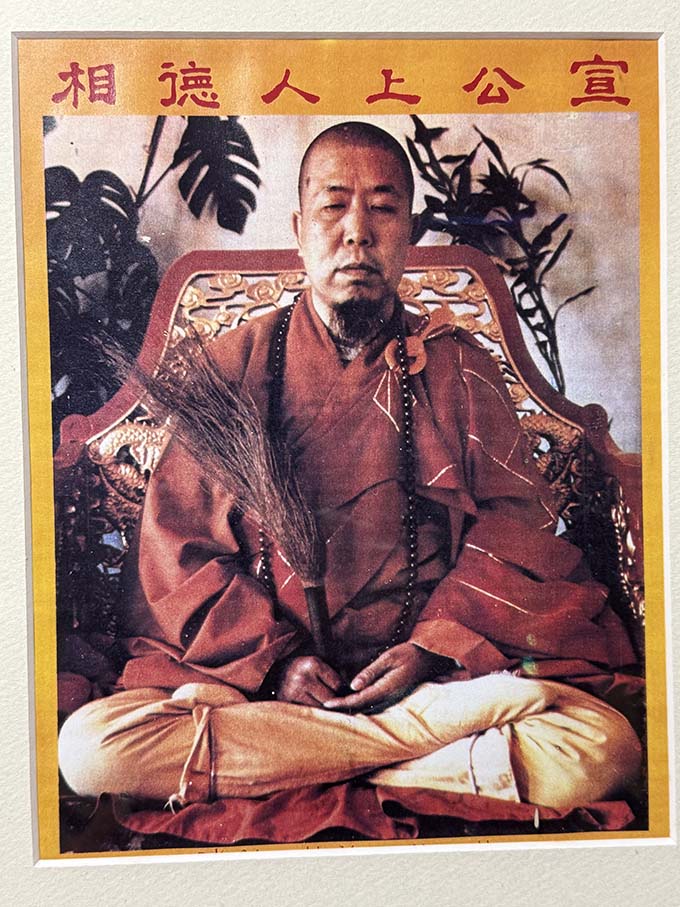
Bhikshu Dharmamitrais one of the very earliest American disciples of the late Weiyang Chan patriarch, dharma teacher, and pioneer of Buddhism in the West, the Venerable Chan Master Hsuan Hua (宣化禪師, 1918-1995). Master Hua founded the Dharma Realm Buddhist Association, the City of 10,000 Buddhas Monastery in Ukiah, California, and more than 20 branch monasteries in the U.S., Asia, and Europe.
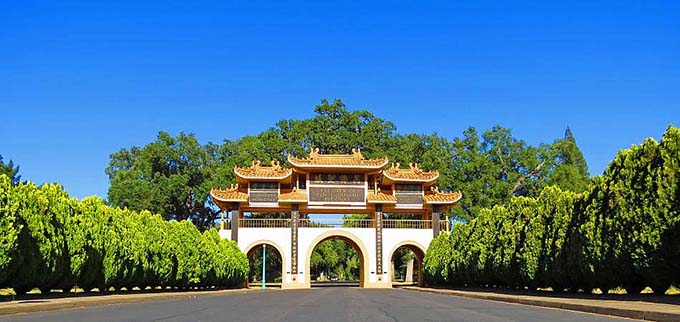
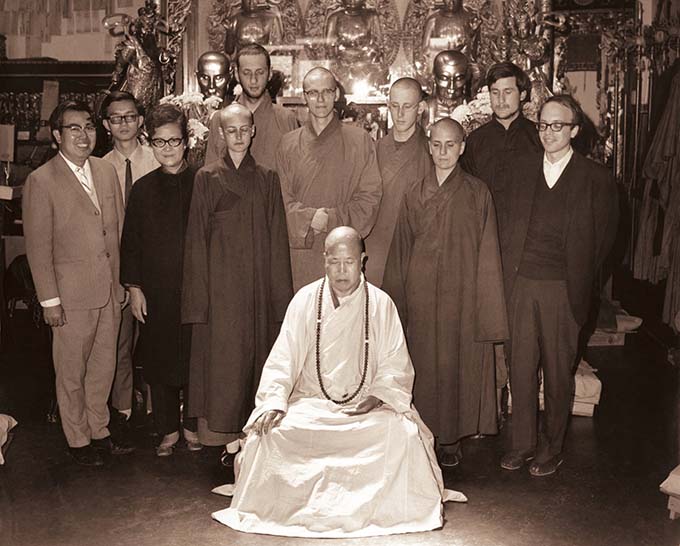
Dharmamitra’s interest in Buddhism began when, after having moved from Tacoma to Seattle in 1966 to attend the University of Washington, he met dharma students of the Venerable Chan Master Hsuan Hua. These students attracted Dharmamitra to San Francisco, where in 1968 he met Master Hua at the Buddhist Lecture Hall in Chinatown, and then attended Master Hua’s first teaching program for Westerners. During that session, in August, 1968, he took the three refuges with Master Hua.
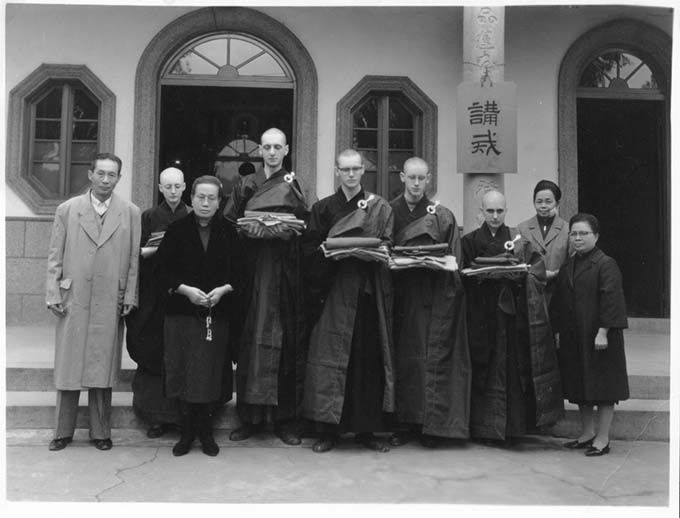
In early summer of 1969, Dharmamitra took the śrāmanera’s novice monk precepts from Master Hua. In mid-autumn of that year, Master Hua sent Dharmamitra to Hai Hui Monastery in Keelung, Taiwan. There he and four other American disciples of Master Hua (three monks and two nuns), became the first Westerners to take full monastic ordination as bhikshus and bhikshunis in Chinese Buddhism.
Dharmamitra has been in robes for a total of 40 years, from 1969‒1975, and 1991 to the present. His training as a translator of Sino-Buddhist Classical Chinese included four years of intensive monastic training and Chinese-language study of classic Mahāyāna texts in a small-group setting under Master Hsuan Hua, from 1968 through 1972.
Dharmamitra also earned a bachelor degree focused primarily on Chinese language at Portland State University in 1988 and studied Classical Chinese full-time one-on-one for a year at the Fu Jen University Language Center near Taipei (1987‒88). He then studied Classical Chinese for two years at the University of Washington’s Department of Asian Languages and Literature from 1988 to 1990, and later returned to UW to audit graduate courses and seminars in Classical Chinese for three more years .
Since taking robes again under Master Hua in 1991, Dharmamitra has devoted his energies primarily to the study and translation of classic Indian Mahāyāna Buddhist sutras, treatises, and commentaries, focusing on works by Ārya Nāgārjuna and related authors. He has published 16 books of translations, perhaps the most significant of which are The Avataṃsaka Sūtra (The Flower Adornment Sutra), Nāgārjuna’s Daśabhūmika Vibhāṣā (Treatise on the Ten Bodhisattva Grounds), The Daśabhūmika Sūtra (The Ten Grounds Sutra), and The Bodhisattva’s Practice of Moral Virtue which includes The Brahma Net Sutra’s 10 Major and 48 Minor Bodhisattva Precepts together with the text of the ceremonies for transmitting these precepts. These are taken by Chinese-tradition monks, nuns, and bodhisattva laity, as well as by monastic followers of Vietnamese, Korean and Japanese Buddhism.
Dharmamitra chose these particular scriptures out of his personal resolve to translate into English the very bodhisattva path scriptures Master Hua spoke highly of or taught. Foremost among these is The Avataṃsaka Sūtra, otherwise known as The Flower Adornment Sutra, a huge translation project consisting of 2,500 pages in three approximately 850-page volumes. Dharmamitra published this text through Kalavinka Press in 2022, after nearly 10 years of work. He especially chose to translate this classic because his own good spiritual guide, Venerable Master Hsuan Hua, lectured on this sutra nearly every night for about 15 years!
Dharmamitra’s translation of The Flower Adornment Sutra is the first and so far only complete English translation of any edition of the Avataṃsaka Sūtra. This very long collection of bodhisattva path teachings is considered so complete, that it is traditionally referred to as “the Bodhisattva Canon.”
The scenarios that unfold across the course of its 39 chapters introduce an interpenetrating, infinitely expansive, and majestically grand multiverse of countless buddha worlds extending throughout all three periods of time, and all dimensions of space. These reveal a cosmos in which all phenomena are visible in any given phenomenon, and any given phenomenon is visible in all phenomena, appearing in a manner analogous to the vision of the cosmos inferred by the revelations of modern physics in its descriptions of quantum entanglement and quantum non-locality. Meanwhile, the text proceeds to reveal and explain in great detail the cultivation of the bodhisattva path to Buddhahood.
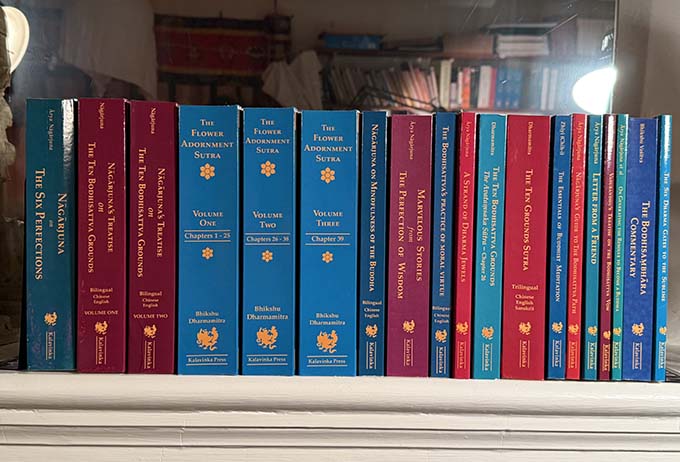
Another especially significant translation produced by Dharmamitra isNāgārjuna’s Treatise on the Ten Bodhisattva Grounds. Extensively annotated by Dharmamitra, it consists of 35 chapters that explain the cultivation of the 10 highest levels of bodhisattva practice leading to Buddhahood. The text focuses almost exclusively on the first two of the ten bodhisattva grounds: “the Ground of Joyfulness” and “the Ground of Stainlessness.”
Dharmamitra has also translated and published numerous other works by Nāgārjuna. He recommends in particular four works for students and practitioners who may be interested in an accessible introduction to Nagarjuna’s marvelous bodhisattva path teachings:
Nāgārjuna’s Letter from a Friend consists of the three earliest translations of Nāgārjuna’s Suhṛllekha, Nāgārjuna’s spiritual counsel to an Indian monarch offering wonderfully wise spiritual counsel certainly be useful to us all.
Nāgārjuna’s A Strand of Dharma Jewels, Dharmamitra’s translation of Nāgārjun’s Ratnāvalī, a 500-stanza treatise on the bodhisattva path presented in the form of a spiritual advisor’s letter to an Indian king. In it, Nāgārjuna presents both abstruse teachings and practical advice to lay and monastic practitioners.
Nāgārjuna’s Guide to the Bodhisattva Path whichis Nāgārjuna’s Bodhisaṃbhāra Śāstra (Treatise on the Provisions for the Path to Enlightenment). It describes the essential prerequisites for those taking up the path to the highest enlightenment of a buddha. The translation is accompanied by an abridged version of its only commentary, originally written by the early Indian Bhikshu Vaśitva.
Marvelous Stories from the Perfection of Wisdom, consisting of 130 stories and short dharma anecdotes selected from Nāgārjuna’s immense commentary on The Great Perfection of Wisdom Sutra. Each story is “framed” by the inclusion of Nāgārjuna’s introductory and summarizing dharma discussions.
In addition, Dharmamitra has translated two classic Indian-tradition calming-and-insight meditation training texts written by Tiantai Zhiyi, a masater of a Chinese analytical system called the Tiantai hermeneutic tradition. These texts are also accessible to the lay reader, and are essential for anyone wishing to learn Indian Buddhism’s earliest śamatha-vipaśyanā meditation methods.
The Essentials of Buddhist Meditation or The Essentials for Practicing Calming-and-Insight and Dhyāna Meditation is a calming-and-insight (śamatha-vipaśyanā) meditation manual deeply rooted in the early Indian Buddhist meditation tradition. It offers perhaps the most reliable, comprehensive, and practical traditional Indian Buddhist meditation instruction, currently available in English.
The Six Dharma Gates to the Sublimeserves as an ideal companion volume to The Essentials of Buddhist Meditation. It explains the six subsidiary practices crucial to success in traditional Indian Buddhist breath-focused (ānāpāna) and calming-and-insight (śamatha-vipaśyanā) meditation. Correctly implemented, these six “gates” lead the practitioner to realize the third of the four truths (cessation), of which the “sublimity” referenced in the title is one of the four canonically described practice aspects.
A unique feature of Dharmamitra’s Kalavinka Press translations and publications is his policy of making all of his translations available in special “bilingual” (English & Chinese) editions which include the Classical Chinese source texts in both the traditional and simplified Chinese scripts on the left-hand page, directly opposite the corresponding English translations on the right-hand page. This is done especially to facilitate the training of new generations of Buddhist text translators, and for close study by Buddhologists and students in Buddhist universities, as well as by monastics and laity in Asia and the West.
Bhikshu Dharmamitra invites all readers of the Northwest Dharma News to visit his website, Kalavinkapress.org where all of his translations are available either as perfect-bound books or as completely free high-quality pdf e-books. “Right Dharma” teachings are there, available for us all.
If you appreciate our work, consider a donation.
Bhikshu Dharmamitra is a Seattle-based Chinese tradition translator monk. He is one of the earliest American disciples (since 1968) of the late Weiyang Chan Patriarch, the Venerable Master Hsuan Hua. Master Hsuan Hua (1918–1995) was a pioneer in bringing Classic Indian Mahayana Buddhism and Chan meditation instruction to the West. During his many years in robes, Dharmamitra has devoted his energies primarily to study and translation of classic Indian Mahayana texts, long since lost from Sanskrit but still preserved in very early Chinese translations made between 400 and 800 ce.
Richard Hill is a retired land use attorney. He has meditated for some 30-odd years, first in the Theravada tradition under the guidance of Kamala Masters and Steve Armstrong, and more recently in the Mahayana Korean Zen tradition, under the guidance of Zen Master Jeong Ji and Zen Master Jeong Bong.