
Sravasti Abbey New Buddha Hall: A Place of Peace
Written by: Venerable Thubten Chonyi
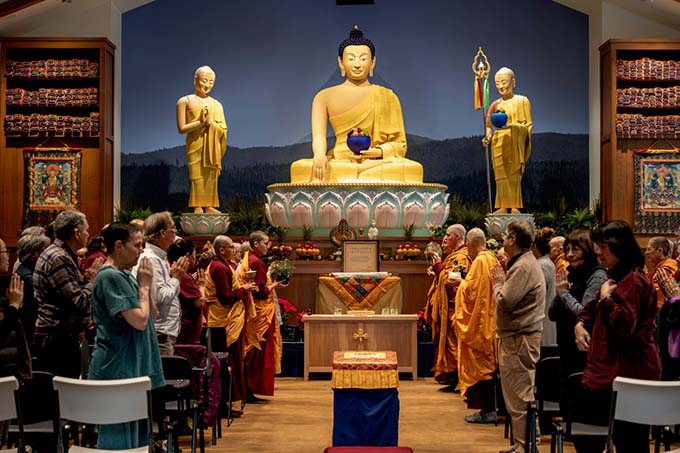
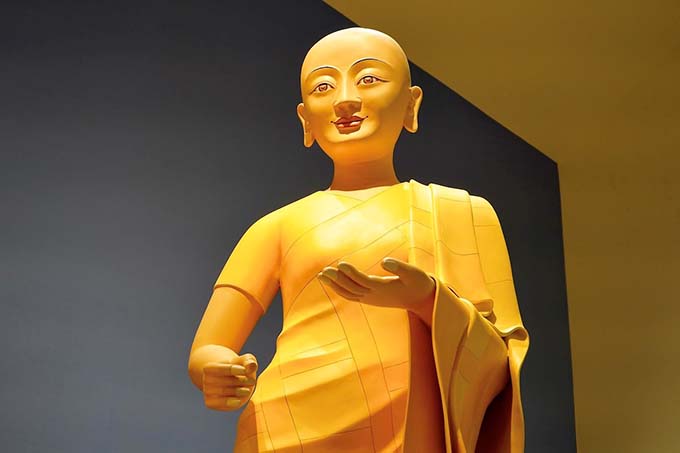
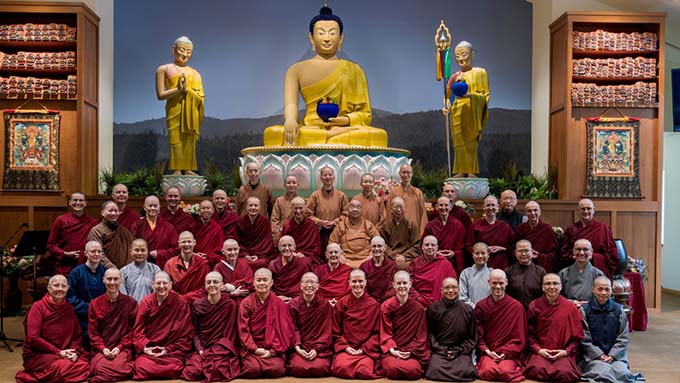
The Buddha Hall features a central statue of the Buddha, plus one of his attendant Ananda, and one of Mahaprajapati, the first nun.
Photos by: Courtesy of Sravasti Abbey, Gen Heywood
After years of planning, continued generosity from supporters, and obstacles surmounted, Sravasti Abbey in Washington state is finally fully using its new Buddha Hall.
The structure, consecrated for the third time in November, 2025, is the final and largest step in the development of the 370-acre monastery, where 22 nuns and monks practice in Tibetan Buddhist tradition.
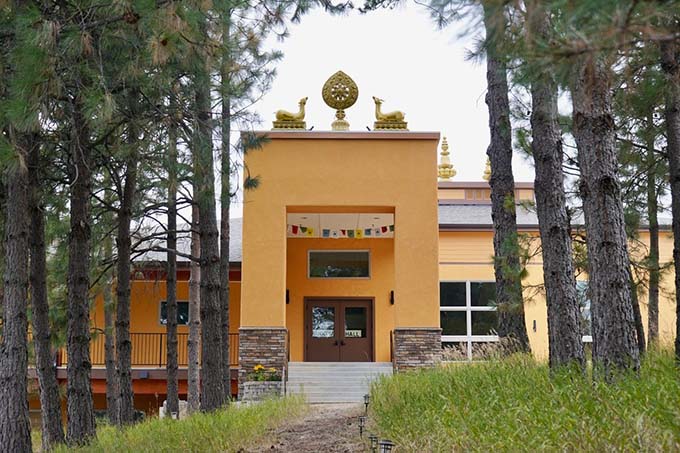
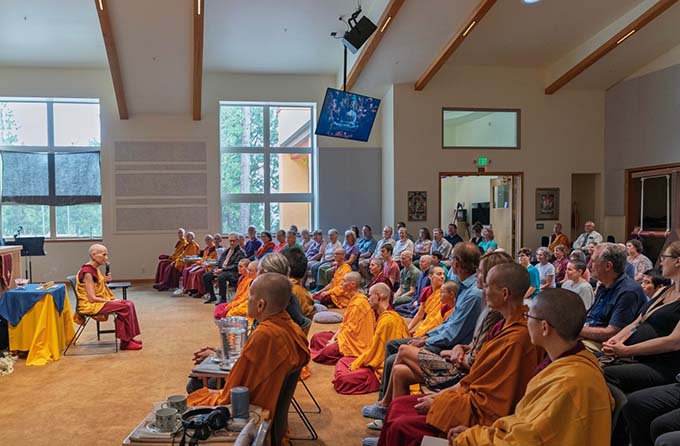
The Buddha Hall is already fulfilling its stated purpose of housing the community’s daily meditation practices, study, sangha ceremonies, chanting rituals, teachings, retreats, pujas, memorials, and special dharma events.
Throughout six years of planning and construction, Venerable Thubten Chodron, the abbey’s founder and abbess, never lost sight of the building’s larger purpose.
“This Buddha Hall is being built by the people and for the people,” she said at the 2022 groundbreaking. “It’s not about physical construction in and of itself. While we are building the Buddha Hall, we are also growing the monastic community, deepening our practice, nourishing an ever-widening network of dharma friends, and building bridges to dharma communities around the world.”
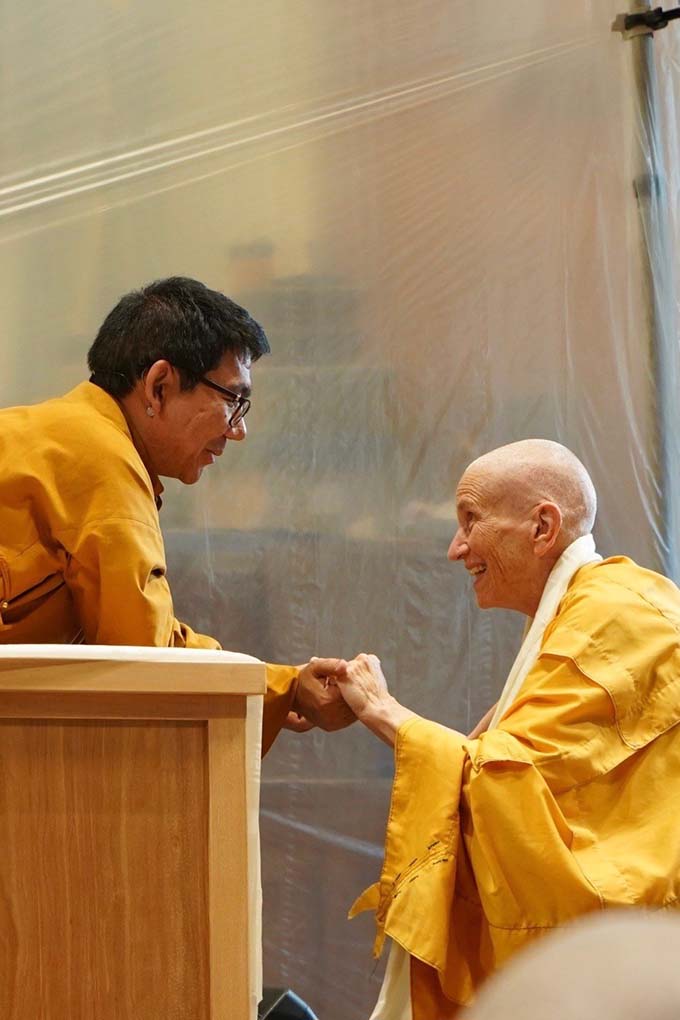
The intent to build a spiritual home for all sentient beings has permeated every aspect of the project.
The November 8, 2025 consecration drew close to 100 people to the monastery’s Newport, Washington site. Several hundred more joined online to celebrate the long-awaited temple and library. It will serve as the practice, teaching, and learning hall for Sravasti Abbey residents and guests, far into the future.
Filled with beautiful paintings, photographs, statue and texts, the Buddha Hall is a reflection of the love, compassion and wisdom that all beings can realize for themselves.
The Buddha Hall
At 17,000 square feet, the Buddha Hall was planned to accommodate Sravasti Abbey’s growth for the foreseeable future. The main hall on the upper floor can seat 100 people. It features a beautiful, nature-inspired altar with custom statues by well-known Buddhist sculptor Peter Griffin.
The central Shakyamuni Buddha statue on the altar is 10 feet high. It is flanked by exquisite images of Ananda, the Buddha’s attendant; and Mahaprajapati Gotami, his stepmother and founder of the nuns’order.
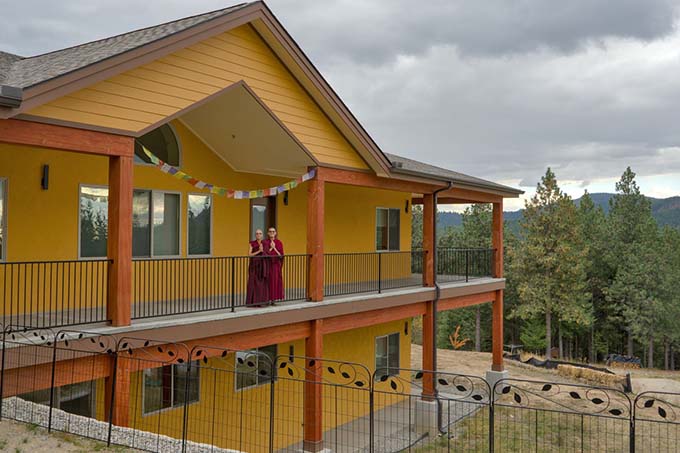
One smaller side hall, the Tara Room, adds additional teaching and meditation space. Another, the Posadha Room, is where the sangha performs its monastic rites. Each room can seat about 50 people. The lower story contains a large library, offices, classrooms, and workrooms.
The Buddha Hall is built from Faswall, an environmentally friendly building product with a high insulation value. Faswall is virtually fireproof and is not susceptible to insects, rodents, or rot. Its composite materials are all natural and will last for centuries.
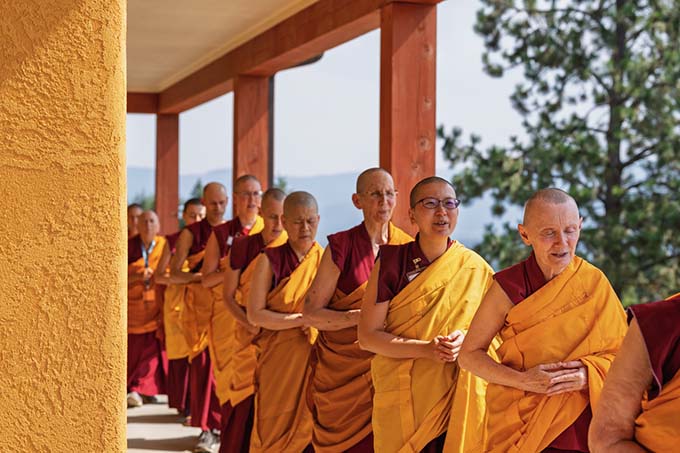
Exterior walls are finished with stucco and painted a warm gold, similar to the color of Tibetan monasteries. A covered deck encircles the upper floor, inviting the Tibetan practice of kora, circumambulating the temple and the sacred objects inside it. A sophisticated audiovisual system and well-designed acoustics, provide excellent sound and enhanced video streaming capabilities.
While the Buddha Hall has a contemporary Western design, it includes Tibetan-style roof ornaments. These two features adorn many Tibetan temples: rooftop ganjiras (spires) that represent the five Buddha families, and deer and dharma wheel on a parapet above the main entrance. These were handcrafted from copper by an artisan family in Nepal, then painted a glistening gold by an autobody shop in Priest River, Idaho.
Many more beautiful thangkas (sacred paintings) and statues have been offered to fill the rooms with beautiful images. These are meant to inspire faith in the three jewels— Buddha, dharma, and sangha—the qualities they embody, and humans’ capacity to cultivate these qualities.
Planning and Construction
The Buddha Hall has been in the abbey’s plans since its earliest days, but more pressing needs came first. The original Sravasti Abbey property included a large house, an adjacent garage, and a rickety old barn. Within the first year, the hand-built log cabin garage was remodeled into a meditation hall.
Lifting the former garage’s ceiling, and adding clerestory windows and an entranceway foyer, made a cozy practice space that served the community for 21 years. With maximum seating capacity for around 50 people, the meditation hall housed twice-daily meditation sessions, monastic rituals, ordinations, and hundreds of meditation retreats and dharma courses over the years.
Over time, as the resident community grew and attendance increased, the monastery added smaller cabins and two large buildings. By 2018 the garage-sized meditation hall was often packed with people, which necessitated relocating larger events to the dining room. That’s when planning for the Buddha Hall began in earnest.
Tim Wilson of Idaho-based Momentum Architecture had designed the two earlier buildings, and was looking forward to the day he could start on the Buddha Hall. He called it “a project of a lifetime,” and worked closely on the design with Abbess Thubten Chodron and the seasoned Sravasti Abbey building team.
Like all building projects, Buddha Hall construction met with obstacles, delays, and unexpected costs. Although the original hope was to begin construction in 2020, the Covid pandemic postponed the start date to July 2022, and then construction took more than three years. Infrastructure presented a particular challenge. The abbey is located in a rural area of eastern Washington, where there are no public septic or water utilities. These systems had to be designed and built from scratch, which included an extensive upgrade to the abbey’s well water system.
The project has enjoyed tremendous and worldwide support. Thousands of individual benefactors, and countless workers, volunteers, and enthusiastic Buddhist and non-Buddhist supporters, offered resources and merit to help bring this new learning and practice center to completion. Here’s a short overview of the process.
Geshe Gendun Samdup, who led an earlier Buddha Hall blessing ceremony last May, said, “The main purpose of this Buddha Hall is for the flourishing of the Buddhadharma and to benefit sentient beings. Right now, in the current world situation, there is upheaval and so much change. Within that, it is important to have this Buddha Hall. It is a place of peace, and whoever comes to practice here is also sustaining peace for our world.”
Sravasti Abbey invites Buddhists and non-Buddhists alike to study and practice Buddha’s teachings together, in this new spiritual home for all beings.
If you appreciate our work, consider a donation.
Venerable Thubten Chonyi began her Buddhist studies in 1996, with U.S.-born nun and author Ven. Thubten Chodron, at Dharma Friendship Foundation in Seattle. Chonyi took novice ordination with Venerable Chodron at Sravasti Abbey in 2008, and received bhikshuni precepts at Fo Guang Shan Monastery in Taiwan in 2011. Ven. Chonyi has been involved in Sravasti Abbey communications since its founding. She enjoys sharing the dharma in a variety of ways, including interfaith exchange and bringing Buddhist values to social justice issues.