
Volunteers, Generosity, Restore Seattle Betsuin
After 2024 Arson Fire Nearly Destroyed Temple
Written by: Irene Goto and Ann Oxrieder
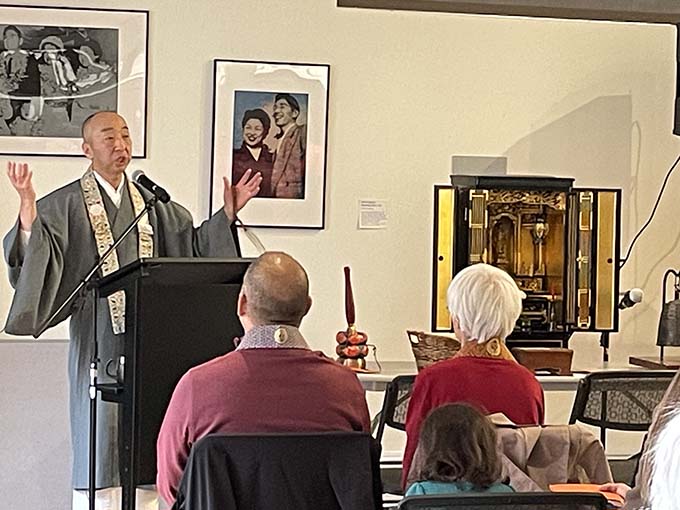
In December Sunday service returned to borrowed space at the Densho Digital Repository’s community room, while the gym is being renovated. Head Minister Rev. Katsuya Kusunoki is shown giving the dharma message beside the borrowed home altar.
Photos by: Courtesy of Seattle Betsuin
Two years after Seattle Betsuin Temple was swept by an arson’s fire and penetrated the entire complex with smoke, Seattle’s oldest Buddhist structure is nearing complete restoration.
The Memorial Hall, which is the east wing of the temple complex, is where the fire erupted and sustained the greatest damage. Its reconstruction is nearly complete. The Main Hall, where services take place, was permeated with smoke into subflooring, inside pillars and attic, and is cleaned, refurbished, and renewed.
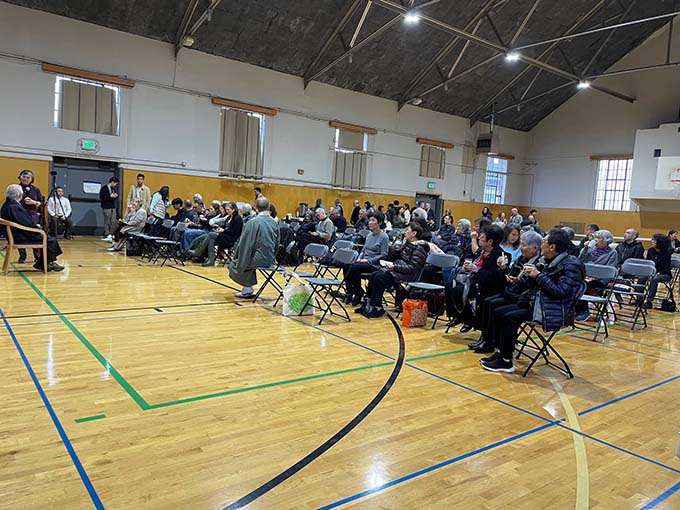
The smoke reached as far as the west wing where the kitchen, dining room, classrooms and gymnasium are located. Smoke reached these areas through air ducting. The classrooms are being cleaned and painted, and the gymnasium’s new HVAC ducts will be installed within the next few months.
While the sangha has been anticipating the re-opening since the fire, they have found creative ways to continue services in the interim.
Temple leaders hope to fully re-open the temple in March or April, 2026, after construction and the permitting process are complete. Although the exact date is yet to be determined, the temple will certainly open in time to observe Seattle Betsuin’s 125th anniversary celebration. The temple first opened on Nov. 15, 1901. Other reopening celebrations are being planned for all of 2026.
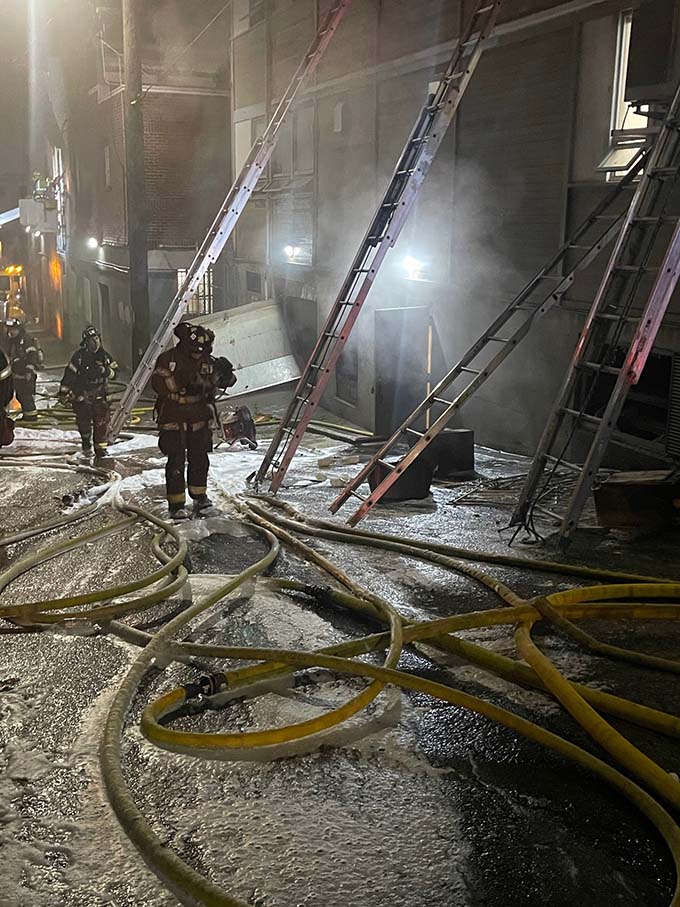
The initial fire started on December 31, 2023. Then on the afternoon of January 2, 2024, fire broke out again. Temple debris reignited, and smoke, soot, and water damaged virtually the entire 35,000 square feet of the temple complex. Arson fire at Seattle Betsuin destroys archives; man arrested | Nichi Bei News
Despite the fire and smoke the Seattle Betsuin sangha continued to hold Sunday services, first at the Koyasan, White River, and Tacoma Buddhist temples, then in borrowed spaces Seattle Betsuin owns and rents out. Since September, 2024, temple services have been held in the temple’s gymnasium, after it was cleaned and modernized. Services are also livestreamed.
Immediately after the second fire on Jan. 2, the sangha and community came together to rescue archival documents, and to preserve items that had suffered the least damage. Over a four-month period, more than 40 volunteer work parties sorted, dried, cleaned, scanned, and preserved items, in a race against time before mold set in. The temple’s Amida Buddha statue and adornments, were sent to Japan for refurbishment.
Volunteers from the temple, the Densho Digital Repository, the Wing Luke and White River Valley museums, and the Japanese Cultural & Community Center of Washington, all worked together. In addition people from the King County and University of Washington archives, as well as community and national archivists and archivist organizations, shared their time and expertise.
Members, neighbors, and friends from near and far made cash donations. Volunteers spent hours sending personalized thank-you notes to those donors.
The momentous restoration effort
The initial estimated cost to restore the temple was between $5 million and $6 million, a budget influenced by the building’s age, and the need to meet current building codes. Here’s a link to the Seattle Betsuin Arson Restoration & Building Fund. An accounting of expenses will be available after the project is complete.
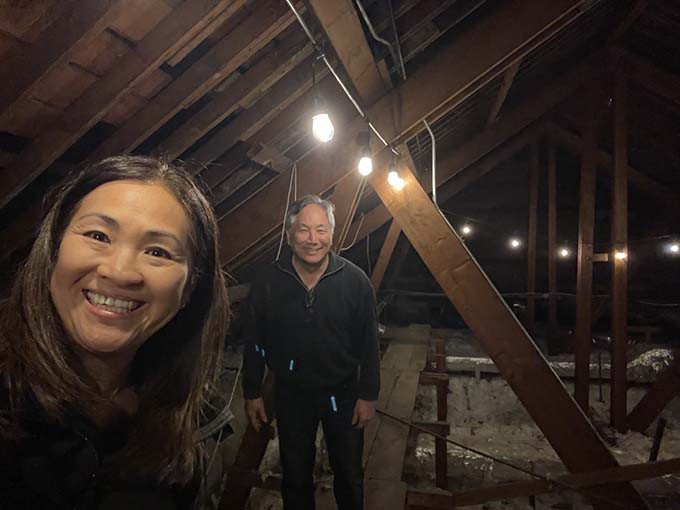
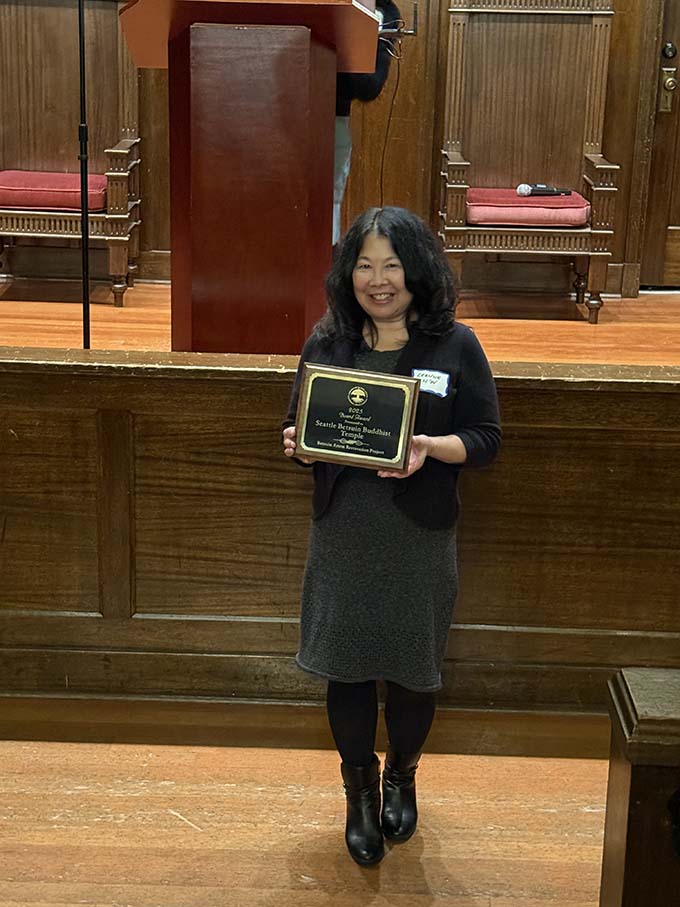
Seattle Betsuin leaders have been volunteering to coordinate the huge job of contracting work and organizing other temple volunteers. Leanne Nishi-Wong has led the Arson Restoration Committee, and the remediation phase. This has included removal of contaminated contents, asbestos materials, and lead-tainted products. Remediation included ice-blasting walls and interiors, ozone treatments, and chemical applications. Cleaning and demolition lasted more than a year.

Grace Tazuma and Gary Shibata volunteered to lead the reconstruction phase. It has included updating wiring to bring electrical systems up to code, structural and seismic reinforcement, painting, insulation, and flooring. In addition, new security features have been added. Temple members volunteered to paint, move furniture, and pack and load altar items for shipment to Japan for repairs.
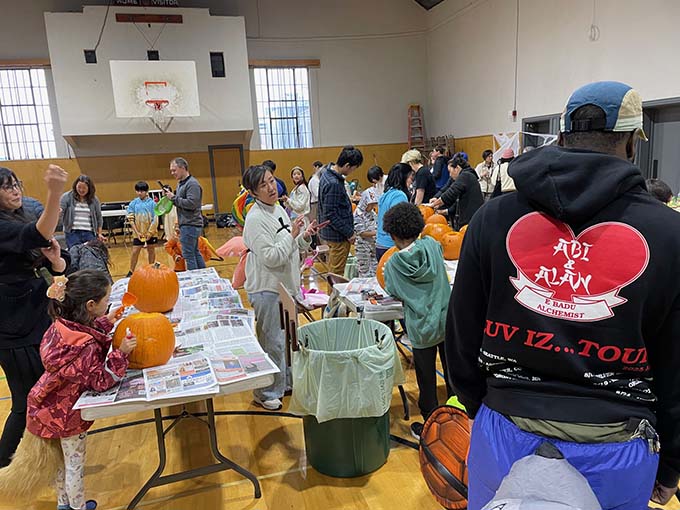
Eight months after the fire, Sunday services moved to the gymnasium. Its open space and basketball hoops have provided a relaxed, friendly atmosphere. After Sunday service, coffee and conversation were enjoyed by the adults, and children were able to be themselves. Rather than sitting in pews, people sat closer together in folding chairs, often rearranged into small groups that invited community discussion. Many attendees lingered after service, getting reacquainted or making new acquaintances. Newcomers entered the gym facing those already seated, who could easily be identified for special, warm welcomes.
One Dharma School teacher said, “…the feeling is casual and free in the gym, enabling people to congregate together…”. Another temple member observed that Dharma Exchange, a discussion after Sunday service, is more lively, animated, and inclusive, perhaps because of the seating arrangement and engaging presentations by invited speakers.
The size of the gym also allowed Dharma Exchange to include small group discussions on a variety of topics such as “Does Artificial Intelligence have Buddha Nature?” In addition, the community has offered Buddhist-themed musical presentations. The informality of the setting also made guest presenters feel comfortable speaking there, even those who may not have been Buddhist. In addition, recently upgraded audio and visual systems have made presentations easily enjoyed by all.
However, the gym is unavailable, once again. The gym is undergoing the final stage of restoration, and in January, Sunday services were once again being held in the Densho community room. Sunday Dharma School, Seattle Betsuin Buddhist Women’s Association, Scouts, Camp Fire, various other groups, and Matsuri Taiko will meet in assigned rooms and other borrowed spaces, or they will meet remotely.
Services—including Sunday, funeral, and memorial ceremonies—have been held in the current temple building for 81 years, except for the four years of World War II when Japanese and Japanese Americans were interned.
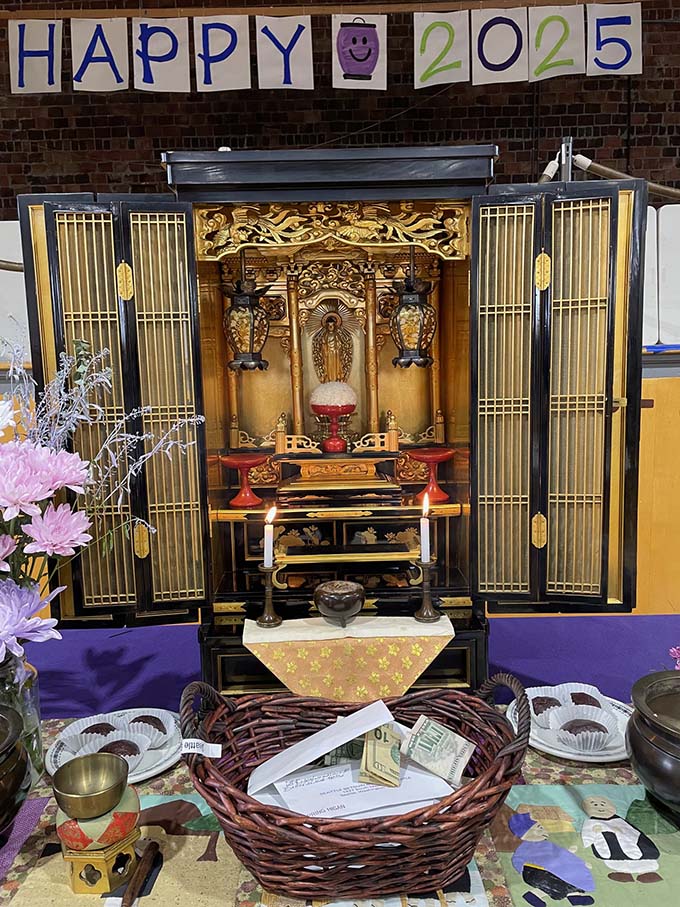
During Shin Buddhist services, followers at home or in the temple sit facing Amida Buddha, the central object of reverence, depicted in statue, picture, or script form. Amida Buddha and surrounding adornments may be arranged on an appointed table or in an appointed cabinet or box. In some arrangements suspended lamps, and colorful carvings of guardian animals and legendary creatures, reference stories told by Shakyamuni Buddha about his time and place.
Amida Buddha, in Shin Buddhist tradition, stands upright in a lotus that symbolizes enlightenment. The beauty of the Amida Buddha arrangement depicts the realm of enlightenment, the Pure Land or Buddha’s land, a land of happiness where one can be at ease, without the burden of worldly attachments. Everyone, Buddhists and non-Buddhists, may visit the altar to offer incense in gratitude for Amida Buddha’s benevolence. Some just sit quietly and gaze at its beauty, while thers chant, “NamoAmidaButsu.”
Sunday services at temple include chanting of a sutra (scripture), a dharma talk, a dharma song (Buddhist hymn), incense offering and monetary donations, and intoning, “Namo Amida Butsu,” (Homage to Amida Buddha).
Only by going forth and reaching enlightenment can we benefit others
In this burning house; this is the natural working of the Vow. – The Collected Works of Shinran p. 401
Immediate, pressing business for the board and the sangha is hosting the 78th Annual Northwest District Buddhist Convention of the Buddhist Churches of America, to be February 14 and 15, 2026, at the Hyatt Regency Lake Washington hotel in, Renton, Washington. Please visit the Seattle Betsuin website for updates on the temple’s re-opening, the Northwest District Buddhist Convention, and 125th anniversary events.
Due to the enormous cost of rebuilding a historic building and bringing everything to code, Seattle Betsuin is still accepting donations through its Arson and Restoration Fund. Contact Leanne Nishi-Wong, for further information.
If you appreciate our work, consider a donation.
Irene Goto and Ann Oxrieder are long-time members of Seattle Betsuin Buddhist Temple. Oxrieder volunteers as a director of the temple board, while Goto volunteers as a minister’s assistant. Our tradition is Jodo Shinshu(The True Essence of Pure Land Buddhist Teaching), also known as Shin Buddhism, and is affiliated with the Nishi Hongwanji temple in, Kyoto, Japan.